The Betty and Barney Hill Abduction
Driving home through the White Mountains after midnight, a respected interracial couple watched a pancake-shaped craft descend toward their car — then arrived home two hours late with scuffed shoes, a torn dress, and no memory of what happened. Under hypnosis two years later, Betty and Barney Hill described the first widely publicized alien abduction, setting the template for every account that followed.
- When
- September 19-20, 1961
- Where
- Lincoln, NH, USA
- Witnesses
- 2
- Physical evidence
- Yes
- Military involvement
- Yes
The Sighting
Betty Hill was a social worker; Barney Hill was a postal employee and NAACP member. On the night of September 19, 1961, they were driving home to Portsmouth, New Hampshire from a short vacation in Niagara Falls and Montreal, heading south on Route 3 through Franconia Notch. Around 10:30 p.m., Betty noticed a bright point of light that seemed to move erratically and grow larger. They stopped several times to watch it with binoculars. Near Indian Head, the object — by then described as a huge, silent, pancake-shaped craft with a row of windows — swooped toward the car and hovered. Through binoculars Barney saw figures at the windows, panicked, and screamed that they were about to be captured. The Hills sped away; soon after, they heard rhythmic buzzing sounds, felt drowsy, and 'came to' 35 miles down the road. They reached home around dawn, roughly two hours later than they should have.
Oddities accumulated: Barney's dress shoes were scraped, Betty's dress was torn and later found coated with a pink powder, their watches never ran again, and shiny concentric circles appeared on the car's trunk that reportedly deflected a compass needle. Betty reported the sighting to Pease Air Force Base on September 21; the report went to Project Blue Book. Ten days later Betty began having vivid nightmares of being taken aboard a craft and examined.
The Investigation
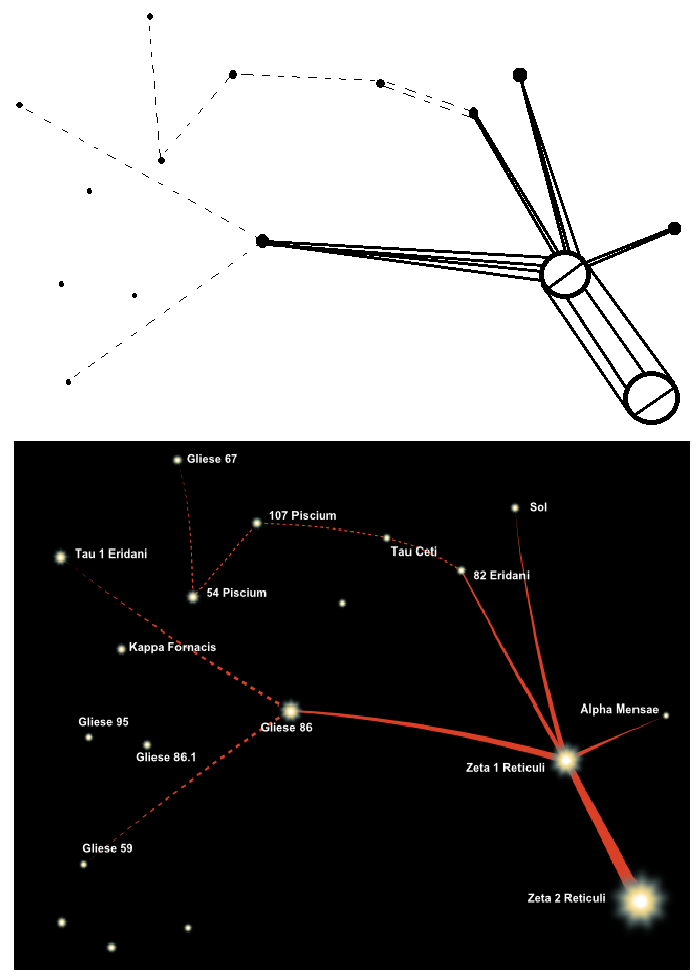
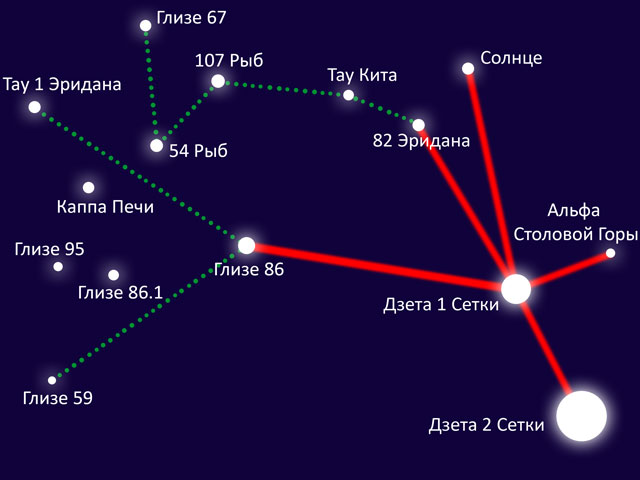
Barney developed anxiety and ulcers, and in December 1963 the couple began sessions with Dr. Benjamin Simon, a prominent Boston psychiatrist and hypnotherapist who had treated shell-shocked veterans. Over roughly seven months of separately conducted, tape-recorded hypnosis sessions, both Hills described being stopped at a roadblock, escorted into a landed craft by short beings with large eyes and grayish skin, and medically examined — needles, skin and hair samples, and for Betty a needle inserted in her navel described as a pregnancy test. Betty recalled being shown a three-dimensional star map marking trade and expedition routes. Asked to reproduce it later, she drew a pattern that amateur astronomer Marjorie Fish, after years of modeling nearby stars, controversially matched to the Zeta Reticuli system, 39 light-years away.
Dr. Simon's own conclusion was careful and often misquoted: he believed the Hills were not lying, but suspected the abduction memories derived from Betty's nightmares, absorbed and elaborated by Barney — a shared fantasy sincerely experienced. Before any of this became public, the Hills had also quietly briefed NICAP, the leading civilian UFO research organization of the era, whose director, retired Marine major Donald Keyhoe, treated the initial 1961 sighting report (stripped of any abduction content, which had not yet surfaced) as a credible radar-adjacent case worth tracking — an early, low-key institutional interest that predates the sensational hypnosis-derived narrative by years. The story leaked to the Boston Traveler in 1965, and John Fuller's 1966 book 'The Interrupted Journey' made the Hills famous worldwide.
The Witnesses
Barney Hill never got to see what his case became. He died on February 25, 1969, of a cerebral hemorrhage at age 46, just eight years after the sighting and only three years into the fame the Fuller book had brought. Betty lived another 35 years, and her trajectory split ufology's opinion of her sharply. She became a fixture of the UFO lecture circuit and, for a time, a genuinely respected figure — but her later career damaged the case's reputation more than any skeptical paper. Skeptic Robert Sheaffer recounted a 1980 National UFO Conference at which Betty presented over 200 photographs she said documented UFOs, consisting, in Sheaffer's account, of 'blips, blurs, and blobs against a dark background'; he wrote that she was 'literally jeered off the stage by what had been at first a sympathetic audience.' By 1977, according to fellow investigator John Oswald, Betty was conducting UFO vigils several nights a week and on one occasion proved unable to distinguish a landed UFO from a streetlight. Serious ufologists increasingly distanced themselves from her later claims while continuing to treat the 1961 case itself as significant — a split between 'early Betty' and 'late Betty' that persists in the literature. She died on October 17, 2004, having never remarried.
The Evidence
The physical traces — the torn dress, the pink powder, the reflective trunk circles, the stopped watches — were never rigorously laboratory-analyzed at the time, a gap both skeptics and believers now regard as the case's great lost opportunity. Elementary-school teacher Marjorie Fish's star-map reconstruction became the era's most technically ambitious piece of UFO evidence, but it did not survive later scrutiny: Carl Sagan and Steven Soter argued the match was a matter of selective, essentially random alignment, and the 1990s Hipparcos satellite mission's more precise distance measurements undercut several of the stars Fish had used to build her configuration. Fish herself eventually stepped back from defending the hypothesis publicly.
The Explanations
Skeptics offer a layered account. The initial light matches the planet Jupiter, bright and near their line of travel that night; Blue Book's evaluation pointed to a misidentification. The 'missing time' may be an artifact of reconstructing a meandering night drive on back roads. New Hampshire researcher Jim Macdonald proposed the Hills misperceived an aircraft warning beacon on Cannon Mountain, with the rest of the experience built from stress, sleep deprivation, and false memories recovered under a procedure — hypnotic regression — now well established as capable of producing sincere confabulation. Researcher Martin Kottmeyer identified striking similarities between Barney's hypnotic recollections and 'The Bellero Shield,' an Outer Limits episode broadcast February 10, 1964, just twelve days before Barney's first hypnosis session, which featured a wraparound-eyed alien; Jason Colavito later found two more relevant episodes from the same February.
Believers counter with the case's stubborn residue: two witnesses of good reputation with nothing to gain and much to lose (an interracial couple courting publicity in 1961 New England risked plenty), physical traces on car and clothing, a contemporaneous report to the Air Force made before any abduction narrative existed, and substantially concordant accounts under separate hypnosis sessions.
Modern Developments
The Hills' case has undergone a genuine scholarly reassessment in the 2020s that has nothing to do with UFOs directly: sociologists, including David Drysdale, have analyzed the abduction narrative through the lens of American race relations, suggesting the story allowed the Hills — an interracial couple in an era when interracial marriage remained illegal in over a dozen U.S. states — to recast themselves symbolically as deracialized 'specimens' studied by beings indifferent to human categories, a reading that treats the abduction account as meaningful cultural testimony regardless of its literal truth. The case continues to generate new cultural products: a 2023 Dark Horse Comics series retold the story for a new audience, and a feature film adaptation titled 'Strange Arrivals' has been in development. The University of New Hampshire's Milne Special Collections continues to hold and periodically exhibit the primary archive — Betty's dress, the Simon hypnosis tapes, and Barney's contemporaneous letters — keeping the case uniquely available to independent researchers compared to almost any other classic sighting.
Why It Endures
Every element of the modern abduction narrative — missing time, the roadside stop, the examination table, the needle, the star map, hypnotic recovery of memory — enters the culture through the Hills. Betty's grey-skinned, big-eyed beings became the canonical 'Grey.' The case created a research paradigm (regression hypnosis) and its own critique (false-memory science), and both still structure the abduction debate from Pascagoula to the present. It also carries a human dimension rare in ufology: the Hills were civil-rights-era pioneers whose ordeal, whatever its source, was clearly real to them.
The site on Route 3 carries a New Hampshire state historical marker, erected in 2011 — the first official monument to an abduction claim in the United States — a small stretch of blacktop now permanently annotated with the sentence that still divides two fields: memory science on one side, ufology on the other, both claiming the Hills as their founding case. The marker's very existence is itself an unusual cultural verdict: no state government agency endorses the abduction as fact, yet New Hampshire chose to memorialize the story's location the way it would a battle site or a birthplace, treating the Hills' account as a piece of the state's documented folk history worth preserving in granite regardless of what actually happened in the White Mountains that September night.
Official investigation
Pease AFB report to Project Blue Book (concluded: probably Jupiter/misidentification)