Airship Occupants (1896-97)
Also known as: The Mystery Airship Pilots, Bearded Inventors
- First known report
- The North American 'mystery airship' wave, November 1896 - May 1897, produced dozens of claimed landings and occupant meetings across the American Midwest and West — decades before the word 'flying saucer' existed and half a century before Roswell.
- Relative frequency
- singular to its own pre-modern wave — the type essentially vanished after 1897 and has no true successor, making it a control case for how differently occupants were once described
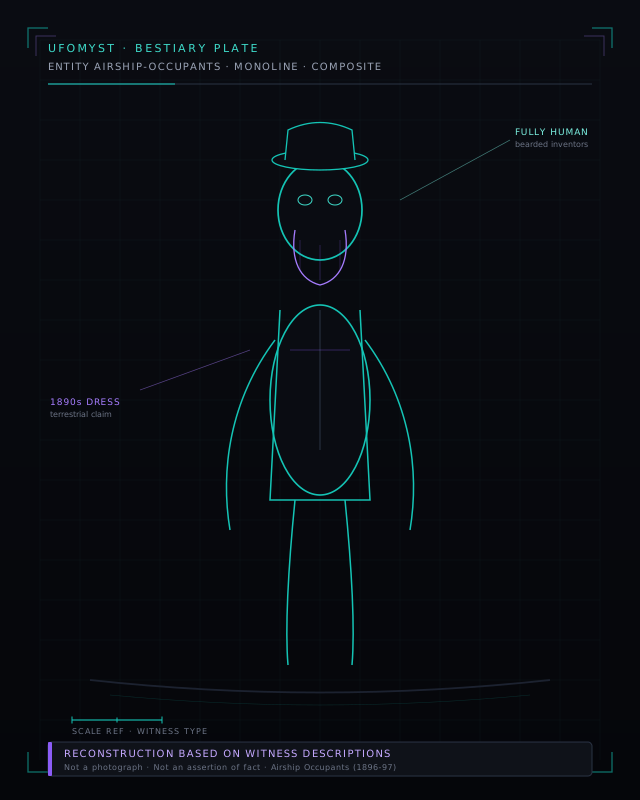
Reconstruction based on witness descriptions
Physical description
Ordinary-looking, fully human men — bearded, well-dressed, often multilingual — who identified themselves as inventors testing a secret flying machine of entirely terrestrial origin. Unlike every later occupant type, witnesses described casual, friendly conversation, requests for water or spare parts, and no paralysis, telepathy, or missing time.
Skeptical reading
Historians (Vallée and Aubeck's 'Wonders in the Sky' chief among them) read the airship occupants as a direct product of 1890s invention-fever: Edison, the Wright brothers' predecessors, and a booming dime-novel genre about lone genius aviators primed the public to expect a human inventor rather than a visitor from elsewhere. Most individual sightings are now attributed to Venus, meteors, and outright newspaper hoaxes competing for circulation — the era's version of the modern flap. The type's total disappearance after 1897, replaced within decades by explicitly non-human pilots, is itself treated as evidence for the culturally-generated reading of the entire occupant phenomenon.