Men in Black
Also known as: MIB
- First known report
- Harold Dahl's Maury Island claim (June 1947) includes the first black-suited warning visitor; Albert Bender's 1953 shutdown of his International Flying Saucer Bureau, popularized by Gray Barker's 'They Knew Too Much About Flying Saucers' (1956), built the legend into a recurring archetype.
- Relative frequency
- occasional as first-hand reports, enormous as folklore
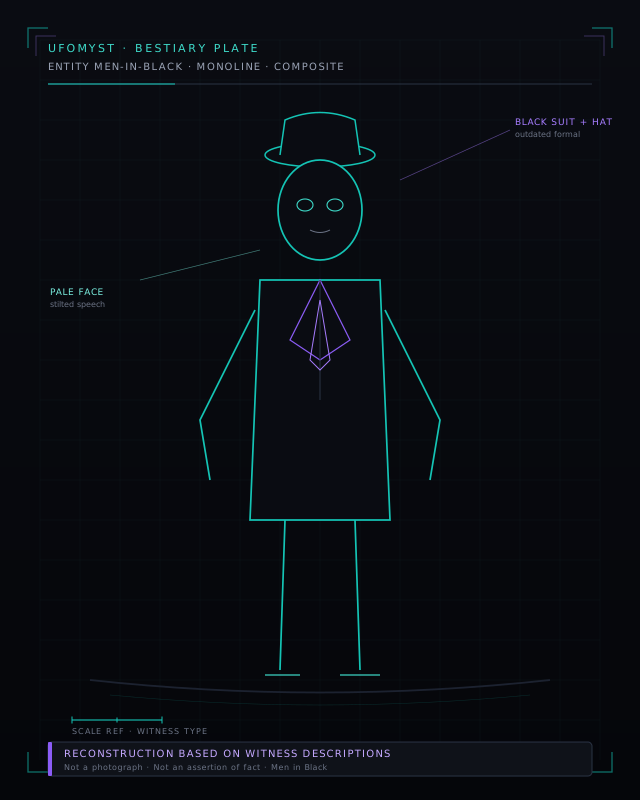
Reconstruction based on witness descriptions
Physical description
Not occupants but visitors-after-the-fact: pale men in outdated black suits and hats, arriving in immaculate vintage black Cadillacs, speaking in stilted formal English, knowing unpublished details of a sighting, and warning witnesses to stay silent. Frequently described with subtle wrongness — no eyebrows, waxy skin, mechanical diction, an unnatural way of eating or blinking. Excluded from Huyghe-style morphological classification because they present as ordinary humans; the anomaly is behavioral, not physical.
Skeptical reading
Documented hoax roots: Maury Island collapsed as a fabrication, and Barker privately treated MIB lore as entertainment he was consciously embellishing. Real government visits to witnesses (Air Force, FBI) during the Blue Book era gave the legend a factual seed to grow from. Folklorists treat the MIB as a modern secularization of demonic-visitor traditions; John Keel, who popularized the term 'Men in Black,' saw them instead as an active part of the wider phenomenon rather than a separate hoax layer.
Famous cases
- maury-island-1947
- bender-1953
- aeromar-mib-vitoria
- point-pleasant-mothman-1966-67