The USS Roosevelt Encounters (Gimbal / GoFast)
For nearly a year, F/A-18 crews training off the U.S. East Coast picked up strange objects daily on upgraded radar — and one pilot nearly hit a 'cube inside a translucent sphere.' Two infrared videos from those squadrons, Gimbal and GoFast, leaked in 2017 and were confirmed by the Pentagon. Lieutenant Ryan Graves took the safety case to Congress: whatever they were, they were in the training airspace and nobody knew it.
- When
- 2014-2015 (videos January 2015)
- Where
- Atlantic, off Virginia/Florida coast (W-72), VA, USA
- Witnesses
- 50
- Physical evidence
- Yes
- Military involvement
- Yes
The Sighting
Beginning around 2014, after their APG-79 AESA radar upgrade, Super Hornet crews of Carrier Air Wing One — training with the USS Theodore Roosevelt in Warning Area W-72 off Virginia Beach and later off Jacksonville — began detecting unknown objects with startling regularity: sometimes daily, holding station in high winds, moving at hypersonic and then loitering speeds, remaining aloft for hours without transponders, exhaust, or visible means of lift. Pilots initially wrote the tracks off as radar ghosts from the new system; then the objects began appearing on FLIR pods and, eventually, eyeballs. In late 2014, two Hornets flying trail had an object pass between them — described by the flight lead to squadron mate Lieutenant Ryan Graves as a dark cube suspended inside a translucent sphere, within about 50 feet of the aircraft. The squadron filed an aviation safety (hazard) report; training sorties were adjusted as a result. Lieutenant Danny Accoin, another VFA-11 pilot, described tracking an object on radar and FLIR that he could never gain visually despite ideal geometry — a mismatch between sensor lock and eyeball confirmation that recurred often enough across the squadron to become its own minor mystery within the larger one.
In January 2015, aircrew recorded the two videos later named for their content: "Gimbal," an infrared clip of a lens-shaped object skimming above the cloud deck that appears to stop and rotate on its axis as the aircrew exclaim "there's a whole fleet of them" (a formation visible on the situational display beyond the frame the camera shows); and "GoFast," an object apparently racing low over the water as the crew whoop at the difficulty of locking onto it with the targeting pod.
The Investigation
The squadrons' hazard reports moved through Navy safety channels without public result at the time. The story broke on December 16, 2017, when The New York Times published the videos alongside its AATIP exposé; the To The Stars Academy, the private venture co-founded by musician Tom DeLonge, had obtained and released them ahead of the newspaper's own reporting. On April 27, 2020 the Department of Defense formally released Gimbal, GoFast, and FLIR1 together, confirming their authenticity and labeling the phenomena "unidentified" in an official statement — the Navy's first formal acknowledgment in decades that it possessed and stood behind footage of this kind. Graves and Accoin went public with their names attached in 2019; Graves — among the first active-duty-era pilots to speak systematically and on the record about the phenomenon — testified before Congress in July 2023 that UAP were seen "regularly" in military training airspace, that the great majority of encounters go unreported because of career stigma among aircrew, and that the objects represented at minimum a flight-safety hazard and at maximum a potential national-security problem depending on their true origin. The Roosevelt encounters became core exhibits in the ODNI's June 2021 preliminary assessment (144 reports reviewed, 143 left unexplained) and in the subsequent creation of AARO, the Pentagon's standing UAP investigative office.
The Explanations
Skeptical analysis has been most effective against the videos themselves rather than against the broader radar pattern. GoFast: parallax analysis using the pod's own on-screen telemetry, performed independently by analyst Mick West, suggests the object is very likely slow-moving — perhaps 30 to 40 knots, consistent with a balloon or a bird — at roughly 13,000 feet, with its dramatic apparent speed in the video an artifact of the much faster-moving camera platform sweeping past it; AARO itself later endorsed a version of this reading in its own review. As West put it in describing his general approach to the videos, "what we've got to go with here is the simplest explanation, and really the simplest explanation is that it's just a plane," adding that a lack of complete data does not, by itself, make an exotic explanation the likely one. Gimbal: the object's apparent "rotation" matches a known artifact of the ATFLIR pod's optics — a gimbal-roll effect that occurs as the camera mechanism tracks through the nose-on position relative to the aircraft, causing the glare pattern to visibly rotate even if the underlying object does not — making the clip compatible with nothing more than the exhaust glare of a distant conventional jet as seen from an unusual angle. Critics of that reading, including Graves, respond that the accompanying radar picture — never released publicly — showed a genuine formation of objects stopping and reversing course against winds measured at 120 knots, a maneuver no glare artifact could produce and data the public has simply never been allowed to check for itself. The radar tracks more broadly: possible artifacts of the newly installed AESA systems still being tuned to fleet conditions, or, in a darker reading some analysts float, evidence of classified U.S. drone or high-altitude balloon programs being tested against an unwitting fleet — an explanation that would resolve the persistence and impunity of the objects at the cost of implying the Navy had hazarded its own aircrews without telling them what they were flying against.
The unresolved core is the totality rather than any single clip: years of multi-sensor correlation across radar, FLIR, and direct visual sighting; near-midair reports involving structured objects at close range; and dozens of aircrew witnesses across multiple squadrons and multiple years — a pattern that no single artifact explanation, however individually persuasive, covers in full, and that the government, after several rounds of formal review, still officially lists as unidentified rather than closed.
Graves After the Cockpit
Graves's own trajectory after leaving active duty is itself part of the case's legacy. A former F/A-18 pilot with no prior ufological interest or affiliation, he has described going public in 2019 as a calculated professional risk, expecting the same career-ending ridicule that had kept his squadron mates silent for years — instead finding, within a few years, congressional committees, national television, and a receptive Pentagon reform process. He has been careful, in nearly every public appearance since, to frame the issue explicitly as unresolved rather than extraterrestrial, repeating that his and his colleagues' concern is what they don't know sharing military airspace with their own aircraft, not any specific theory about what the objects are. That deliberate restraint — advocating for taking the data seriously without claiming to know what it proves — has made him an unusually durable spokesperson across a field that regularly loses credibility to overreaching claims, and it is a large part of why the Roosevelt case, alone among Navy encounters, produced a witness who became a recurring, trusted fixture of subsequent congressional hearings rather than a one-time headline.
Why It Endures
The Roosevelt encounters transformed the UFO question from "what happened that one night?" into "what is in our airspace every single day?" — recasting the entire subject as persistent, statistical, and operational rather than anecdotal and historical. Graves's safety-and-stigma framing gave working pilots institutional cover to file reports without fear of ridicule or career damage, seeded the Pentagon's subsequent reporting reforms, and made him the field's most consequential living advocate-witness, a role he formalized by founding Americans for Safe Aerospace. Together with the Nimitz Tic Tac, these cases form the modern evidentiary spine of the entire UAP era: officially released sensor data, named witnesses under oath, and mundane explanations — balloon, glare, sensor artifact — that are individually plausible for any single clip and collectively insufficient to close the broader file.
Institutional consequences have continued to compound in the years since the videos' release. The Navy formalized UAP reporting procedures for aircrews in 2019, explicitly citing the need to destigmatize such reports after years of pilots staying quiet exactly as Graves had described. Americans for Safe Aerospace, Graves's organization, had by the mid-2020s received hundreds of pilot reports from both civilian and military aviators, becoming something close to the clearinghouse the FAA itself never built for the subject. A further wave of transparency arrived in 2026, when a presidential directive ordered federal agencies to identify and release UAP-related records; the resulting declassification surfaced roughly 162 additional files spanning decades of military reports, intelligence assessments, and eyewitness accounts, officials cautioning that none confirmed non-human origin even as the release kept cases like Roosevelt's formally open rather than quietly archived. The Roosevelt data question remains unresolved in the most literal sense available to the public: the full radar and sensor-fusion records that aircrew say showed formations maneuvering against 120-knot winds have still never been released in the years since Graves first described them to Congress — meaning the strongest claimed evidence in the entire case remains, more than a decade after the fact, exactly where the missing files of ufology's earlier eras always ended up: behind a classification stamp nobody with the authority to remove it has yet chosen to lift.
Official investigation
Navy hazard reports; videos officially released by DoD (2020) as 'unidentified'; central to ODNI 2021 UAP assessment and congressional hearings
Evidence & media
1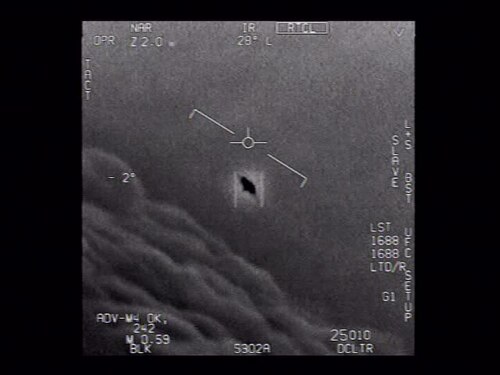
Frame from 'GIMBAL,' the official US Navy targeting-pod video recorded during 2015 training flights linked to the USS Theodore Roosevelt carrier strike group — one of three UAP videos the Department of Defense declassified and released in 2020.Source ↗