The USS Nimitz 'Tic Tac' Encounter
During training off San Diego, the cruiser Princeton's state-of-the-art radar spent days tracking objects that dropped from 80,000 feet to the sea in seconds. Sent to investigate, Commander David Fravor met a white, wingless 'Tic Tac' that mirrored his jet, outmaneuvered it, and vanished — then reappeared 60 miles away. The Pentagon released the infrared video in 2020 and still calls it unidentified.
- When
- November 14, 2004
- Where
- Pacific Ocean, ~100 mi SW of San Diego, CA, USA
- Witnesses
- 8
- Physical evidence
- Yes
- Military involvement
- Yes
The Sighting
In early November 2004, the USS Princeton, a guided-missile cruiser screening the carrier USS Nimitz off Baja California, began detecting anomalous radar tracks with its newly upgraded SPY-1 system: objects appearing at 80,000 feet — above any air lane — then descending to hover near the sea surface in under a second, movements senior radar operator Kevin Day found so extreme he first suspected system error. Recalibration confirmed the tracks. After several days, on November 14, the Princeton took control of two F/A-18F Super Hornets from strike fighter squadron VFA-41 on a training hop — Commander David Fravor, commanding officer of the squadron, with Lieutenant Commander Alex Dietrich flying wing, each with a weapons systems officer — and vectored them to a real-world intercept.
Arriving overhead, the aviators saw a disturbance in the water — a churning oval like something just submerged or about to surface — and above it a white, oblong object roughly 40 feet long, shaped, in the description that named an era, like a Tic Tac breath mint: no wings, no rotors, no exhaust, no visible propulsion, moving erratically above the whitewater. Fravor descended in a spiral to engage; the object, he testified, mirrored his descent on the opposite side of the circle, then accelerated abruptly and "was gone in under a second" — like a bullet, all four aircrew agreed. Minutes later the Princeton reacquired an object at the flight's pre-briefed CAP point 60 miles away: whatever it was had apparently anticipated their rendezvous. A second launch, Lieutenant Commander Chad Underwood, acquired an object on his ATFLIR targeting pod, recording the roughly 90-second video that would later become famous as "FLIR1": an oblong shape without exhaust plume that jerks out of frame at the clip's end as the pod loses lock. Underwood himself coined the "Tic Tac" nickname afterward, saying the comparison was partly inspired, half-jokingly, by a sight gag in the 1980 comedy film Airplane! — a small, dark irony given how seriously the name would come to be taken.
The Investigation
At the time: almost nothing. Aircrew were debriefed informally amid some ridicule from colleagues; no safety report or formal investigation followed, and personnel later described data — radar tapes, communications records — being collected by unidentified officials, a claim never officially confirmed. The case surfaced publicly in December 2017, when The New York Times revealed the Pentagon's Advanced Aerospace Threat Identification Program (AATIP) and published FLIR1 alongside the Roosevelt videos. In April 2020 the Department of Defense formally released the footage, confirming its authenticity and stating the phenomena remain "unidentified." Fravor and Dietrich testified publicly — Dietrich to CBS's 60 Minutes, Fravor under oath before the House Committee on Oversight and Accountability in July 2023 alongside former Navy pilot Ryan Graves and intelligence officer David Grusch — with accounts consistent across two decades. Before the committee, Fravor summarized the encounter in the line that has become the case's epitaph: "the technology that we faced was far superior than anything that we had," adding that USS Princeton's radar had tracked multiple anomalous vehicles descending from 80,000 feet to the surface in less than a second. The 2021 Office of the Director of National Intelligence preliminary UAP assessment and the subsequent establishment of AARO, the Pentagon's All-domain Anomaly Resolution Office, trace their institutional lineage directly to this case and its Roosevelt-era companions.
The Transmedium Question
One detail of the Nimitz case has taken on outsized significance in the years since: the churning disturbance in the water beneath the hovering object, which several witnesses described as consistent with something large moving just below the surface before the Tic Tac itself appeared above it. Proponents have folded this into a broader "transmedium" theory — the idea, later given semi-official currency when the Pentagon's own reporting framework began using the term "unidentified anomalous phenomena" instead of the airspace-limited "UAP," that whatever these objects are, some are described moving between air and water without apparent difficulty or deceleration, a capability far beyond any known submarine or aircraft technology. Skeptics regard the water disturbance as almost certainly unrelated to the aerial object — ordinary wave action, a school of fish, or an artifact of viewing angle from a fast jet — and caution that retrofitting a decades-old detail into a fashionable modern theory is exactly the kind of narrative drift that erodes a case's evidentiary value over time. The disagreement has never been resolved because no submarine or sonar data from that day has ever been published alongside the radar and FLIR record, leaving the ocean half of the encounter, unlike the air half, effectively undocumented.
The Explanations
Skeptical analyses concede the witnesses' competence and attack the inference chain instead. The radar tracks: a known failure mode of newly upgraded systems is spurious "ghost" tracks generated by software or calibration issues during a system's early operational period — though Day maintains the returns were high-confidence and recalibration ruled out simple error. The visual encounter: possibly a misperceived conventional object (a drone, a balloon, even wave effects) with speed and acceleration misjudged in a featureless over-ocean environment lacking reliable size and distance cues; four trained observers agreeing is powerful evidence but not immune to a shared illusion under unusual viewing conditions. The FLIR1 video, analyzed frame-by-frame by skeptics such as Mick West, shows nothing kinematically extraordinary on its own: the final "jump" out of frame matches the pod's gimbal mechanism losing track as it reaches the edge of its steering range, and the object's apparent motion is consistent with a distant, ordinary aircraft viewed through a narrow thermal lens. The reappearance at the CAP point could be coincidence or a second, unrelated artifact track. On this reading, the case is an accumulation of individually ordinary anomalies fused into one narrative by compelling storytelling.
The counter-case: the same events involved four independent sensor and witness channels — SPY-1 radar over multiple days, four aircrew eyeballs at close range in daylight, ATFLIR infrared imagery, and, per Day, concurrent tracks correlated across systems — all pointing toward objects with no visible flight surfaces performing accelerations that violate known aerodynamics. The principals are among the most credentialed witnesses in the history of the subject and have staked two-decade careers and sworn congressional testimony on the account. No drone or aircraft of 2004 — or, proponents note, of 2026 — hovers at 80,000 feet, drops to sea level in seconds, and outruns a Super Hornet without wings, rotors, or a discernible heat plume, and the U.S. government, after every review conducted since, has declined to explain it.
Why It Endures
The Tic Tac is the hinge of modern UFO history: the case that moved the subject from tabloid margins to the front page of The New York Times, from anonymous "believers" to fighter pilots testifying under oath, and from blanket denial to a standing Pentagon office with a congressional reporting mandate. It reset the evidentiary standard for the entire field — multi-sensor, multi-witness, military-documented — and made "UAP" the accepted term of art in place of the older, more tabloid-coded "UFO." Structurally it is Tehran 1976 with better sensors and JAL 1628 with living, named, decorated witnesses willing to put their names behind it; the continuity of the phenomenon's described performance across those decades is itself among the strongest arguments proponents make that something real and unexplained recurs across time rather than emerging fresh from each era's particular cultural moment.
The case's institutional afterlife has only deepened with time. Day, Fravor, and Dietrich have each given extended interviews and written or contributed to books on the encounter in the years since 2017, turning what was once a whispered squadron story into one of the most publicly documented military UAP cases on record. Congressional interest, seeded directly by this case, produced not just the 2023 hearing but a running sequence of subsequent legislative and executive actions; a further wave of declassification in 2026, when a presidential directive ordered federal agencies to identify and release UAP-related records, surfaced roughly 162 additional military and intelligence files spanning decades — material officials characterized as containing no confirmed evidence of non-human origin, but which nonetheless kept the Nimitz case's central question, unresolved since 2004, in the government's own official queue rather than filed away as a closed matter. Fravor's summary before Congress stands as the case's plain-language core, repeated in nearly every retelling since: it was far superior to anything we had, and I would know — I flew against it.
Official investigation
Pentagon (AATIP review); FLIR1 video officially released by DoD in 2020 as genuine and 'unidentified'
Evidence & media
1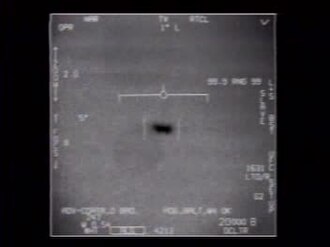
Frame from 'FLIR1,' the official US Navy F/A-18 targeting-pod video of the object encountered off San Diego during the 2004 USS Nimitz carrier strike group exercises — one of three UAP videos the Department of Defense declassified and released in 2020.Source ↗