The Belgian UFO Wave
Beginning with two policemen near Eupen in November 1989, thousands of Belgians reported an immense, silent triangle with three white lights gliding at rooftop speed. At its peak, Belgian F-16s locked radar onto a target that dived from 10,000 feet in seconds — and the Air Force held a press conference admitting it could not explain the events. It remains the most institutionally documented UFO wave in history.
- When
- November 1989 - April 1990
- Where
- Eupen / Wallonia, Belgium
- Witnesses
- 2000
- Physical evidence
- No
- Military involvement
- Yes
The Sighting
On the evening of November 29, 1989, gendarmes Hubert von Montigny and Heinrich Nicoll, patrolling near Eupen in eastern Belgium, watched a massive triangular platform pass slowly overhead: three brilliant white lights at the corners, a pulsing red-orange light at center, and at most a faint hum. Over the following hours, colleagues and civilians across the region — roughly 150 reports, including a second gendarme pair and observations of the object seemingly hovering near the Gileppe dam — described the same craft. This was the opening night of a wave that ran through April 1990 and produced, by the count of SOBEPS (the Belgian Society for the Study of Space Phenomena), some 2,000 recorded witness statements out of thousands of reported sightings, with estimates for the whole wave often quoted above 13,000. The signature was consistent: a dark triangle or platform of great size, flying very low and very slowly — sometimes hovering — in silence, with corner lights, capable of departing at extreme acceleration.
The Investigation
Belgium responded like no country before or since. The Belgian Air Force cooperated openly with SOBEPS's civilian scientists; the gendarmerie logged reports systematically; radar stations were placed on alert. On the night of March 30–31, 1990, following gendarme visual reports and radar contacts at multiple stations (Glons and Semmerzake among them), two F-16s scrambled and made several radar lock-ons over the ensuing pursuit. The recorded data showed startling target behavior — in one pass, a descent from around 10,000 to 5,000 feet and speeds jumping to over 1,000 km/h within seconds, implying accelerations no piloted aircraft could survive. The pilots never obtained visual contact. In a July 1990 press conference, Colonel Wilfried De Brouwer, Chief of Operations of the Air Staff, presented the data and stated the Air Force could not identify the phenomena — an official, uniformed "we don't know" unique in the annals of the subject. De Brouwer, who retired a Major General, has defended the wave's core mystery ever since, including in a 2010 press conference alongside American researchers where he reaffirmed, as a retired general with nothing left to gain from the claim, that hundreds of the reports remained genuinely unexplained.
The Photograph and Its Confession
No single artifact did more to fix the Belgian triangle in public memory than the "Petit-Rechain photograph" — a slide, apparently taken in April 1990 by an anonymous local man, showing a dark triangular craft with three beams and a glowing center hanging over a garden. SOBEPS examined it, NASA and other institutions reportedly looked at it, and for roughly two decades nobody could conclusively identify it as fake; it became the wave's cover image, reprinted in books, magazines, and television documentaries worldwide as the best photographic evidence UFO history had ever produced. Then, on July 26, 2011, in an interview with the Belgian television channel RTL-TVI, a man named Patrick Maréchal came forward and confessed: he had built the object himself, cutting a piece of polystyrene into a triangle, painting it black, embedding a flashlight in each corner, and suspending it from a string to photograph against the night sky — a prank, he said, meant simply "to fool his workmates." The confession detonated through ufology exactly as the TASS wire had detonated through Voronezh two years earlier: two decades of institutional credibility, from a national research society to NASA, undone by one man deciding to explain the joke. SOBEPS's successor organizations were forced to publicly retire the image as evidence, and skeptics have used the episode ever since as ufology's cautionary tale about how a single, well-timed hoax can carry a case's public iconography for a generation before the truth surfaces — often only because the hoaxer himself eventually wants credit.
The Explanations
Subsequent analysis eroded the March 30–31 radar case as well: meteorologists and physicists — including consultants to SOBEPS itself, and later the Belgian military — concluded the F-16 lock-ons were probably anomalous propagation and ground-clutter artifacts under that night's atmospheric conditions, with the jets at times effectively chasing each other's returns; the ground-visual "dancing lights" that triggered the scramble in the first place match bright stars scintillating in exceptionally clear, cold air. Skeptics such as Marc Hallet and Jean-Michel Abrassart have argued the entire wave was a largely self-sustaining social phenomenon: helicopters and aircraft misperceived under heightened expectation, mass-media amplification following the first police reports, and a civilian investigation body whose framing — actively soliciting "triangle" reports through publicity — encouraged pattern-matching in ambiguous sightings. Proposed mundane stimuli have included helicopters, AWACS surveillance aircraft, and rumored (never confirmed) American stealth platforms such as the F-117 or a hypothetical classified "black triangle" program; the United States formally denied operating stealth aircraft over Belgium at the time.
The residue is nonetheless substantial: hundreds of close-range, low-altitude, multi-witness reports of a silent structured platform — many from police officers professionally trained to observe and report accurately — that no combination of helicopters and stars comfortably explains; the striking geographic and descriptive coherence of the opening Eupen night, before any media coverage could shape later accounts; and the plain fact that the Belgian military, with full radar and intelligence access, closed nothing and explained nothing on the record. De Brouwer's considered position, held for over three decades now, stands as the case's institutional core: the wave contains a hard residue of unexplained observations that the confirmed radar artifacts and the confessed photograph do not touch.
Why It Endures
The Belgian wave is the high-water mark of official transparency in UFO history — the only case where an air force scrambled jets, shared the tapes, sat beside civilian researchers, and admitted bafflement on camera. It cemented the giant silent triangle as the defining UFO archetype of the late twentieth century, inherited from Hudson Valley and bequeathed to Phoenix. For skeptics, it is the definitive demonstration that even radar plus F-16s plus policemen can build a mirage — and that one confessed photo hoax can carry a wave's public iconography for twenty years before the truth surfaces. For proponents, it remains the strongest case that something structured and unhurried surveyed a NATO country for months. Both readings agree on the lesson Belgium taught: openness does not dissolve the mystery; it documents it in exhaustive, embarrassing, permanent detail.
The wave's scientific afterlife also set precedents that outlasted the confession. SOBEPS published two dense volumes, Vague d'OVNI sur la Belgique, containing witness maps, statistical breakdowns, and the full radar analyses — the closest thing ufology has produced to a peer-reviewable national dataset — and physicist Auguste Meessen's studies of the F-16 recordings, whatever the eventual fate of his conclusions, modeled how such data should be argued: publicly, with the numbers on the table for anyone to check. When Belgium's successor group COBEPS revisited the files in the 2010s, it downgraded several once-famous sub-cases, including folding the Maréchal confession properly into the record, while explicitly declining to downgrade the March 30–31 radar-visual sightings as a whole — a rare instance of a UFO research body publicly correcting itself case by case rather than either abandoning or doubling down on the file wholesale. Three and a half decades on, the wave remains a fixture of Belgian regional identity around Eupen and Liège, marked on anniversaries by local press retrospectives revisiting the original gendarme witnesses, several of whom, now retired from the force themselves, have continued giving occasional interviews that repeat the founding night's account essentially unchanged. De Brouwer, in the handful of interviews he has continued to give as a retired general with no career left to protect, has held the line he first drew at that 1990 press conference: no identification, no explanation, and no apology for having said so on the record as a serving officer — a stance that, unlike the photograph, no confession has ever come along to unmake.
The 2010s and 2020s also brought a broader reassessment of the "black triangle" genre the Belgian wave popularized. As the American public reporting record filled with vetted military triangle sightings — pilots and radar operators describing large, silent, low-flying delta or triangular shapes off both U.S. coasts well into the 2010s — Belgian researchers pointed to those newer cases as a form of independent, decades-later corroboration of the wave's core morphology, even though the American reports involve different sensors, different militaries, and no confirmed connection to Belgium's own 1989–1990 file. Skeptics counter that a recurring silhouette across unrelated countries and decades says more about a shared reporting template — and about what advanced stealth aircraft of any era tend to look like from below — than about a single ongoing phenomenon. The argument, unresolved, mirrors the wave itself: neither side has produced the one document that would end it.
Official investigation
Belgian Air Force cooperation with SOBEPS; F-16 scramble of March 30-31, 1990 officially reported by Col. De Brouwer
Evidence & media
2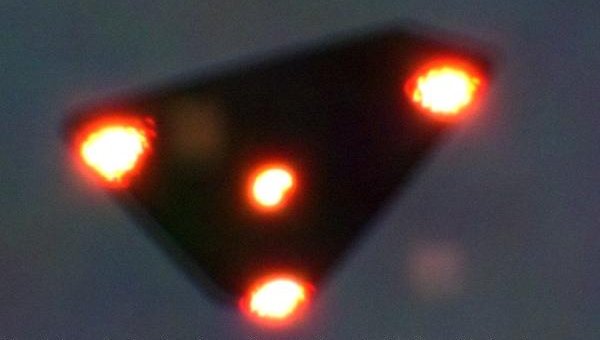
The famous Petit-Rechain 'black triangle' photograph, widely circulated during the 1989-1990 Belgian wave — its creator publicly admitted in 2011 that it was a hoax staged with a styrofoam model.Source ↗ 
Diagram reconstructing the triangular-craft sightings reported by Belgian police and military witnesses during the 1989-1990 wave.Source ↗