The Washington, D.C. Flap
For two consecutive weekends in July 1952, radar scopes at Washington National Airport and Andrews Air Force Base tracked clusters of unknown objects over the U.S. capital while pilots and ground observers saw unexplained lights. Jets were scrambled, headlines screamed 'SAUCERS SWARM OVER CAPITAL,' and the Air Force held its biggest press conference since World War II.
- When
- July 19-26, 1952
- Where
- Washington, DC, USA
- Witnesses
- 40
- Physical evidence
- No
- Military involvement
- Yes
The Sighting
At 11:40 p.m. on Saturday, July 19, 1952, air traffic controller Edward Nugent at Washington National Airport spotted seven unidentified blips on his radar scope, fifteen miles south-southwest of the city — an area with no known traffic. Senior controller Harry Barnes watched the targets drift over the White House and the Capitol, then accelerate abruptly; one was clocked leaving the scope at a computed speed of several thousand miles per hour. Radar at Andrews Air Force Base and at National's second scope tracked the same targets simultaneously. Tower personnel at Andrews reported seeing orange fireballs and erratic lights; airline crews aloft reported bright lights that vanished when interceptors approached. Two F-94 Starfire jets from Newcastle, Delaware, arrived after midnight; the objects reportedly disappeared from radar as the jets arrived and returned when they left.
One week later, on the night of July 26-27, it happened again: multiple radar sites painted unknown targets, and this time F-94 pilots reported visual contacts. Lieutenant William Patterson closed on several lights, was surrounded by them, and radioed to ask ground control what he should do — a moment of genuine tension. The lights outpaced him and the targets faded.
The Investigation
The flap landed in the middle of the biggest UFO wave in American history — Project Blue Book logged more reports in 1952 than any other year, a spike so pronounced that no subsequent year of the project's 22-year run ever matched it. National newspapers ran the story above the fold for days; the Washington Post and other major dailies used variations of 'SAUCERS SWARM OVER CAPITAL' as headlines, and wire coverage carried the story internationally within 48 hours, feeding a summer of American saucer coverage that rivaled 1947's original wave in intensity if not in duration. President Truman personally asked for answers. On July 29, Major General John Samford, the Air Force Director of Intelligence, held the largest Pentagon press conference since 1945. Samford attributed the radar targets to temperature inversions — layers of warm air over cool that can bend radar beams downward, painting phantom returns from ground objects — and the visual sightings to stars, meteors, and misidentified lights. Blue Book chief Captain Edward Ruppelt, who investigated afterward, found the response chaotic: he was in Washington during the first flap and learned of it from a newspaper.
Declassified documents later showed the flap had consequences: the CIA convened the Robertson Panel in January 1953, which concluded UFOs were not a direct threat but that public excitement about them was — recommending a policy of debunking that shaped official handling of the subject for decades. The panel, chaired by Caltech physicist H.P. Robertson and stacked with heavyweight scientific talent including future Nobel laureate physicist Luis Alvarez and astronomer Thornton Page, met for barely twelve hours spread across four days in January 1953 before issuing its recommendations — a strikingly brief review, given its lasting influence, that critics have cited ever since as evidence the outcome was largely predetermined by Cold War anxieties about saturating air-defense channels with false reports, rather than by open scientific inquiry into the sightings themselves.
The Witnesses
Radar supervisor Harry Barnes never backed down. Days after the second flap, he wrote that the unknown targets had behaved like something that was 'watching the watchers' — going 'lazy,' in his words, whenever interceptors closed in, then resuming purposeful movement once the jets withdrew. Radar controller Howard Cocklin, present both nights, held to the same account for the rest of his life; in a 2002 interview with the Washington Post, decades after retiring, the 82-year-old Cocklin insisted flatly: 'I saw it on the [radar] screen and out the window.' Airline captain S.C. Pierman, who watched six white, tailless lights for fourteen minutes while waiting for takeoff clearance, gave a calm, precise account that impressed even Blue Book's own investigators. None of the primary witnesses — controllers, pilots, or the Andrews tower crew — ever recanted or substantially revised what they had seen; the dispute that followed was never over their honesty, only over what instruments and eyes had actually recorded.
The Explanations
The temperature-inversion explanation has real physics behind it: inversions were present on both nights, and anomalous propagation is a documented radar phenomenon. The Civil Aeronautics Administration's 1953 technical study supported this reading, and skeptics note that July 1952 was saturated with saucer headlines, priming observers to interpret stars and jet afterburners as saucers.
But the explanation has always had problems, voiced at the time by the men at the scopes. Barnes and his controllers were familiar with inversion clutter and insisted these targets were solid, coherent, and moving purposefully, behaving nothing like the smeared, stationary, slow-drifting returns inversion clutter typically produces on a scope. Radar expert Captain Roy James's inversion theory was formed without interviewing the controllers. Inversions of similar strength occurred on many July nights — yet only two produced coordinated multi-site radar tracks with simultaneous visual reports. Ruppelt himself wrote that the inversion levels measured were too weak to produce strong returns. The case remains carried in Blue Book as explained, and remains disputed in the technical literature; Condon Report researcher Michael Wertheimer, revisiting the radar witnesses in the mid-1960s, found many still disputed the Air Force's account.
Modern Developments
The case has aged into a fixture of popular UAP retrospectives precisely because it happened over the seat of government, with a paper trail. The History Channel's 2019 scripted series 'Project Blue Book' devoted its first-season finale, 'The Washington Merry-Go-Round,' to a dramatized version of the flap, introducing it to a new generation. A 2021 Netflix documentary series, 'Top Secret UFO Projects: Declassified,' revisited the incident with archival footage and interviews built around the declassified Robertson Panel records. Retrospective journalism has continued to treat 1952 as the moment the U.S. government chose its permanent posture toward UFOs: multiple outlets marking the flap's anniversaries in the 2020s have traced a direct institutional line from the Robertson Panel's 1953 debunking recommendation to the skeptical posture Blue Book maintained until its 1969 closure — and, critics argue, to instincts still visible in how the Pentagon's modern AARO office frames its own public messaging.
When David Grusch and other officials testified before Congress in 2023 about alleged secret retrieval programs, journalists and lawmakers repeatedly reached back to 1952 as the clearest historical precedent for a scenario in which the government's public reassurance and its internal alarm diverged sharply — Samford's calm press conference against the CIA's genuinely worried Robertson Panel deliberations held barely six months later. That gap between the public statement and the private assessment is precisely the pattern later UAP whistleblowers claim persists today, which is why the 1952 flap keeps resurfacing in hearings ostensibly about incidents seven decades newer — a reminder that the government's playbook for managing public UFO anxiety was largely written, tested, and refined in a single tense July over the skies of the American capital.
Why It Endures
No UFO event before or since has combined this particular cocktail: unknown targets over the seat of American government, multiple independent radars, scrambled interceptors, pilot visuals, and a national-security apparatus visibly rattled — all splashed across front pages. The image of saucers over the Capitol dome became permanent cultural furniture, endlessly reproduced in films and documentaries. For ufologists, Washington 1952 is the strongest early radar-visual case and the moment official denial hardened into policy via the Robertson Panel. For skeptics, it is the definitive demonstration that radar can lie and that expectation shapes perception. Both camps agree on its importance: it forced the U.S. government to decide, publicly and permanently, how it would talk about UFOs — and the choice it made in July 1952 echoes through every Pentagon statement on UAP today.
Two details keep the case alive in the archives. First, the interception posture: press reports that summer stated the Air Force had standing orders for pilots to pursue and, if necessary, engage unidentified objects — 'JETS ORDERED TO CHASE UFOs' ran the headlines — a fact that alarmed observers on all sides and prompted public reassurances. Second, the volume problem: Blue Book logged 717 reports in 1952, and internal CIA memoranda from the period worried less about saucers than about the Soviets weaponizing saucer hysteria — clogging air-defense channels with phantom reports at the moment of a real attack. That national-security logic, not curiosity about the objects, drove the Robertson Panel's debunking prescription. The scopes at National Airport were eventually replaced; the arguments they started never were.
Official investigation
USAF press conference (Gen. Samford, July 29, 1952): temperature inversion; Project Blue Book
Evidence & media
2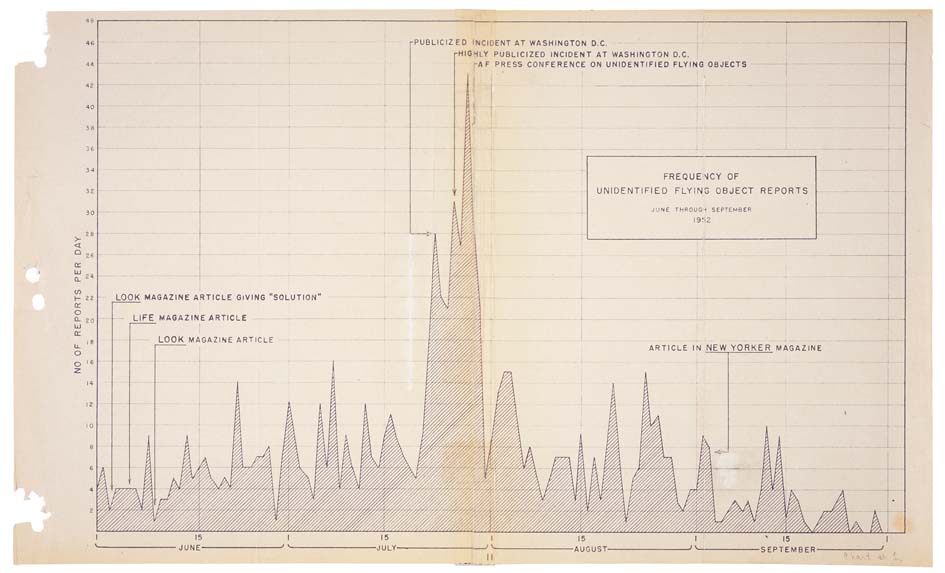
Appendix I to Project Blue Book Status Report No. 8, the US Air Force's official tally of UFO reports during the summer of the Washington National Airport radar/visual incidents.Source ↗ 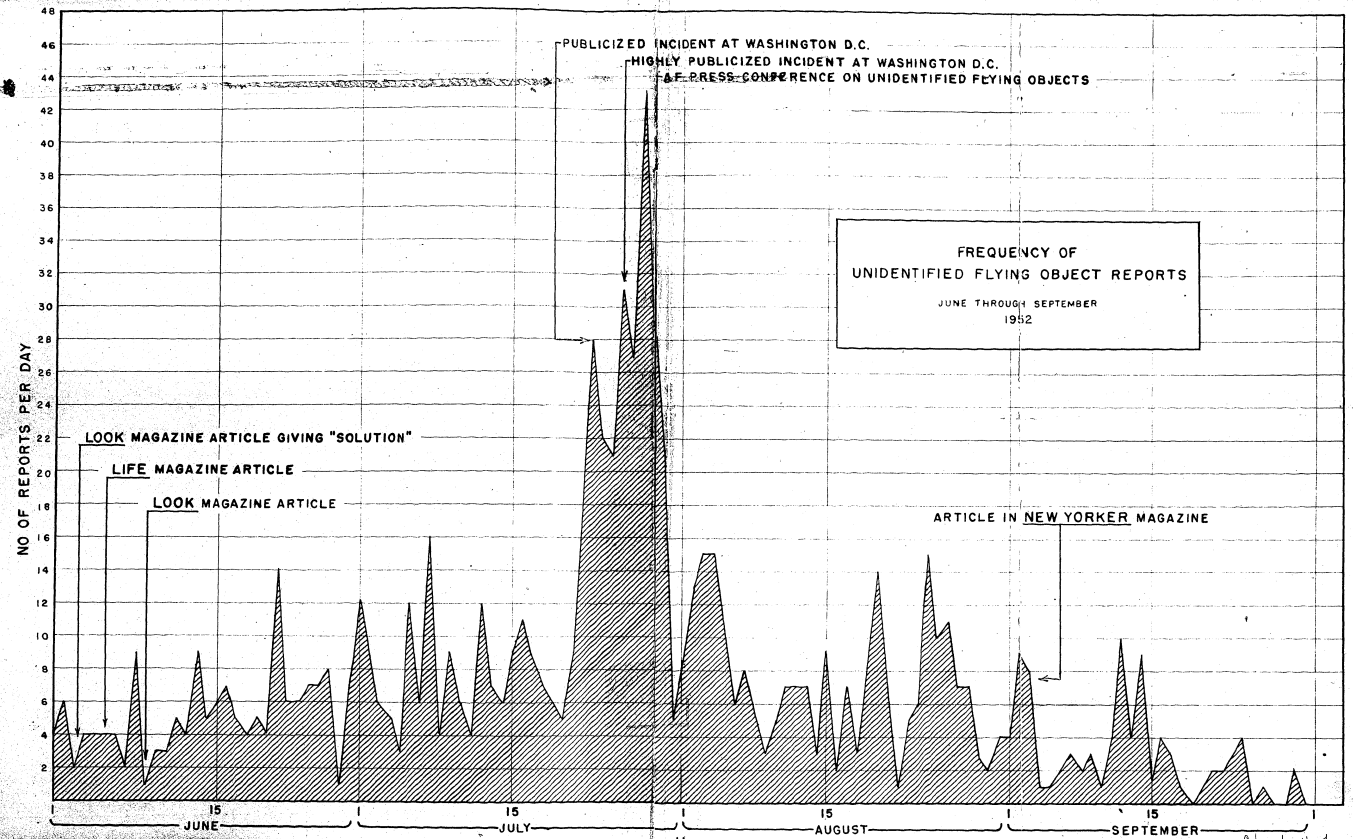
US Air Force frequency graph of UFO reports, June-October 1952, spanning the two July weekends of the Washington 'flap.'Source ↗