The Phoenix Lights
On a single March evening in 1997, thousands of Arizonans reported two spectacles: a vast, silent V of lights gliding from Nevada to Tucson, and later a string of brilliant orbs hanging over Phoenix. The second was traced to military flares. The first was witnessed by pilots, police — and, he admitted a decade later, the governor of Arizona, who called it 'otherworldly.'
- When
- March 13, 1997
- Where
- Phoenix, AZ, USA
- Witnesses
- 10000
- Physical evidence
- No
- Military involvement
- Yes
The Sighting
The evening of Thursday, March 13, 1997 produced the largest mass UFO sighting in American history — actually two distinct events. Between roughly 7:55 and 8:45 p.m., witnesses along a 300-mile corridor from the Nevada line through Prescott, Phoenix, and on toward Tucson reported a formation of five to seven lights in a V or boomerang, moving slowly southeast. Many described not just lights but a single rigid object: a wedge or carpenter's-square shape that blotted out stars as it passed, enormous — estimates ran from hundreds of feet to more than a mile across — flying low, slowly, and in total silence. Witnesses included police officers, pilots, air-traffic-qualified observers, and families out watching for the comet Hale-Bopp, then at its brightest — thousands of extra eyes on the sky that particular week.
At about 10:00 p.m. came the second event, the one the cameras caught: a strand of nine brilliant amber orbs blossoming over the Estrella Mountains southwest of Phoenix, hanging in an arc for several minutes before winking out one by one. This footage led newscasts worldwide and became "the Phoenix Lights" of popular memory, even though most serious investigators consider it a wholly separate phenomenon from the earlier V.
The Investigation
There was, initially, almost none. Luke Air Force Base said nothing was amiss; city councilwoman Frances Barwood, who publicly asked questions on residents' behalf, was ridiculed for her trouble. In June 1997, Governor Fife Symington staged a press conference at which an aide in an alien costume was unveiled as the "culprit" — a joke that witnesses found contemptuous of a genuine mass event involving thousands of their neighbors. USA Today's front page that month reignited national attention regardless. The 10 p.m. event was eventually solved credibly: the Maryland Air National Guard's 104th Fighter Squadron, at the Barry M. Goldwater Range for Operation Snowbird, confirmed its A-10s had dropped LUU-2 illumination flares at high altitude around 10 p.m.; analyses matching the lights' sequential disappearance to the Estrella ridgeline as the flares sank behind it are persuasive, and most researchers on all sides accept the flare explanation for the second event.
The 8 p.m. V has never received an official explanation. The Air Force suggested, indirectly, a flight of A-10s in formation returning from Nevada under standard lighting. A decade on, in 2007, Symington — a former Air Force officer himself — reversed himself publicly and dramatically: he had seen the V over Phoenix that night, described it in interviews as bigger than anything he had ever seen and unlike any machine he knew, telling reporters plainly, "I'm a pilot and I know just about every machine that flies. It was bigger than anything that I've ever seen," and calling the object "otherworldly." He explained the costume stunt as an attempt to head off public panic during his governorship, and apologized for it years later, saying "responsible people" besides himself had also seen the object.
Symington's Reversal
Symington's 2007 admission remains the single most quoted piece of testimony in the case's history, and it is worth dwelling on why. He was not a casual bystander: a former Air Force pilot, later governor of Arizona from 1991 to 1997, he was as close as the case gets to an unimpeachable aviation-literate witness with every institutional incentive to say nothing. Instead, a decade removed from office and with nothing left to gain politically, he told journalists — and later repeated on camera for multiple documentary crews — that the object he watched from his own backyard was not a formation of aircraft he could identify, that its silence and scale were unlike anything in his experience as a pilot, and that his 1997 costume press conference had been a calculated act of political theater designed to defuse a public he feared was on the edge of panic, not an honest assessment of the evidence. He has since said he regretted the stunt more than almost anything else from his time in office, precisely because it taught two generations of Arizonans that officialdom would rather mock a genuine mystery than sit with the discomfort of not having an answer. His account has not changed in any interview since 2007, and he has continued, into the case's later anniversaries, to distinguish carefully between the two events — insisting the flares are a real, separate, solved phenomenon, while the V he personally saw remains, in his words, unexplained.
The Explanations
For the early V, the skeptical solution is a formation of five A-10 Thunderbolts (or other aircraft) flying a southeast route at altitude: formation lights seen against a dark desert sky merge perceptually into a single object, "occlusion" of stars is a known contrast illusion along a lit formation's implied surface, silence is expected for high aircraft, and size and altitude are effectively unjudgeable at night without reference points. Reported speeds and paths are consistent with aircraft timelines, and some witnesses using binoculars did resolve separate airplanes — a fact skeptics weight heavily. Mitch Stanley, an amateur astronomer, reported seeing individual planes through his Dobsonian telescope that night, one of the few witnesses to have brought actual optical instruments to the sighting.
The counter-case rests on the closest witnesses: dozens described a solid structure at low altitude — some directly overhead at a few hundred feet, filling the sky, moving far too slowly for jets, with lights that did not resemble navigation lighting; a formation explanation requires all of them to have misjudged catastrophically while independently agreeing with each other on the object's size, shape, and behavior. No squadron ever stepped forward to claim the 8 p.m. corridor flight despite the enormous and sustained publicity, and FOIA requests over the following years produced no matching flight records — odd for what should have been a routine, loggable ferry flight. The event's dual structure lets each side claim victory: skeptics point to the solved flares, proponents to the unsolved V, and the public's conflation of the two into a single "Phoenix Lights" legend has muddied every debate since.
Why It Endures
The Phoenix Lights is the defining mass sighting of the modern American era — the night the giant silent triangle of Hudson Valley and Belgium arrived over a major metropolis and a sitting governor watched it. It demonstrates, in one case, the full machinery of the phenomenon's social life: a genuine mystery, a partial mundane solution, official mockery followed by belated candor, and a public memory that fused two events into one legend. Annual commemorations, documentaries, and Symington's confession keep it current, and every anniversary the flares-versus-craft argument replays in local Arizona media. Whatever crossed Arizona at 8 p.m., it earned the case's epitaph, spoken by its most famous witness: "It was enormous. It just felt otherworldly."
The documentary record remains oddly thin at the center: the V produced remarkably little usable footage (home video of the era struggled with dim, slow-moving lights against a black sky), so the case rests overwhelmingly on testimony — collected in bulk by researchers including Dr. Lynne Kitei, a Phoenix physician and witness whose two-decade investigation became the event's most sustained chronicle. Kitei's book, The Phoenix Lights... A Skeptic's Discovery That We Are Not Alone, and the accompanying documentary she executive-produced with Steve Lantz Productions, The Phoenix Lights... We Are Not Alone, features interviews with fellow witnesses alongside Apollo 14 astronaut Edgar Mitchell, whose own post-NASA advocacy for UFO disclosure lent the film a rare credential of authority. The case has since been revisited repeatedly in cable documentary programming through the 2010s and 2020s, almost always returning to the same core exhibits: Symington's 2007 reversal, the NUFORC call logs, and Kitei's photographs. The National UFO Reporting Center logged one of its largest single-event report surges ever that night, and its director has noted the calls began well before any media coverage — an important control against contagion explanations for the earliest 8 p.m. sightings, which arrived at the hotline before anyone watching television that evening could have known what their neighbors were seeing. The gap between what thousands of people watched drift silently over their state and what anyone can definitively show remains the case's defining frustration — and, three decades on, its engine.
Phoenix itself has not let the case fade into a niche curiosity. Local Arizona news outlets mark most anniversaries with fresh interviews of aging original witnesses, several of whom — private citizens with no ufological affiliation before that night — have spent thirty years fielding the same questions and giving, by most accounts, the same answers. Barwood, the councilwoman ridiculed in 1997 for taking constituent reports seriously, has been retrospectively vindicated in local reporting as someone who behaved exactly as an elected official should when thousands of residents report the same extraordinary thing on the same evening. The case is now taught, informally, as a case study in how institutions manage — and mismanage — a genuine mass anomaly: the correct handling of the 10 p.m. flares (identify, confirm, publish) sits in the same file as the mishandling of the 8 p.m. V (mock, deny, wait a decade for a retired official to break ranks), and researchers on both sides of the belief divide cite Phoenix as the textbook illustration of both approaches happening in the same city on the same night.
Official investigation
USAF/Air National Guard: 10pm lights were LUU-2 flares from A-10s (Operation Snowbird); no explanation issued for the earlier V overflight
Evidence & media
1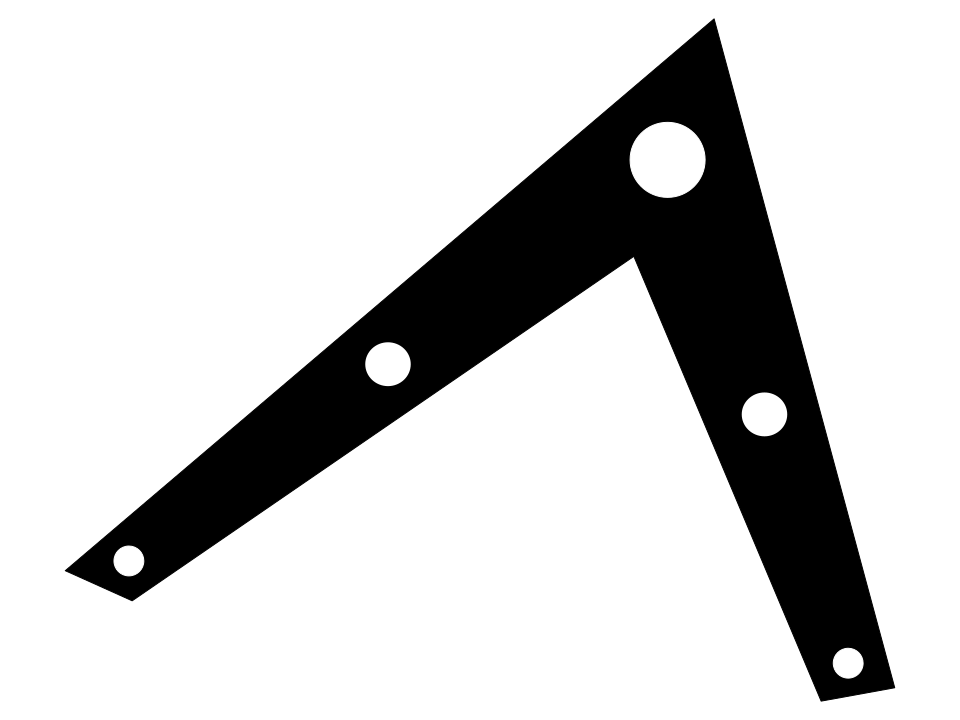
Schematic outline of the V/delta-shaped light formation reported over Phoenix, Arizona on the night of March 13, 1997.Source ↗