The Rendlesham Forest Incident
Over two nights after Christmas 1980, U.S. Air Force security personnel at the twin bases of Bentwaters and Woodbridge tracked strange lights into Rendlesham Forest — one sergeant claims he touched a landed craft etched with symbols. The deputy base commander led a second-night patrol, dictating on tape as a light dripped 'molten metal' and beams fell near a weapons storage area. It is Britain's Roswell, and the argument has never stopped.
- When
- December 26-28, 1980
- Where
- Rendlesham Forest, Suffolk, England, United Kingdom
- Witnesses
- 12
- Physical evidence
- Yes
- Military involvement
- Yes
The Sighting
Around 3:00 a.m. on December 26, 1980, security patrolmen at RAF Woodbridge, a UK base operated by the U.S. Air Force, twin to nearby RAF Bentwaters, saw lights descending into Rendlesham Forest beyond the east gate. Suspecting a downed aircraft, Staff Sergeant Jim Penniston, Airman John Burroughs, and Airman Edward Cabansag went into the woods. What they reported grew in detail over the years, but the core early accounts describe a small metallic object of triangular or conical cross-section, roughly three meters across, glowing amid the trees, with red and blue lights. Penniston later stated he approached, touched its warm surface, and copied raised symbols into his notebook; animals on nearby farms were in commotion. The object, witnesses said, moved off through the trees and lifted away. That morning, servicemen found three indentations in a triangular pattern where it had sat, plus scorch-like marks and broken branches.
On the night of December 27-28, dates in the documents are famously tangled, Deputy Base Commander Lieutenant Colonel Charles Halt was called from a Christmas party: "It's back." Halt led a patrol with radiation and light-intensity equipment, recording a now-famous 18-minute live audio tape. On it, the team measures readings at the landing site, Halt's memo cites peaks of 0.1 milliroentgens in the depressions, and then sights a red, sun-like light through the trees that "winked" and appeared to drip glowing material, breaking into multiple white objects. Star-like objects to the north and south maneuvered for hours; one, Halt wrote, beamed down a stream of light near his position, and, he later said, near the Bentwaters weapons storage area, widely believed to have held nuclear weapons.
The Investigation
Two weeks later Halt sent a one-page memo, "Unexplained Lights," to the UK Ministry of Defence. The MoD registered the report, found "no defence significance," and did not investigate further, a decision defended as proportionate and attacked as willfully incurious ever since. The USAF conducted no known formal investigation, or none released. The case surfaced publicly in 1983 when the Halt memo was obtained under the U.S. FOIA, "UFO lands in Suffolk, and that's official," shrieked the News of the World. The MoD's Rendlesham file, released in 2001, showed little beyond the memo; Halt's tape and later affidavits from Penniston, Burroughs, and others filled the record.
Penniston and Burroughs: A Widening Divergence
The two most prominent first-night witnesses have told increasingly different stories as the decades passed, and the divergence is itself now a major subject of case analysis. In the earliest 1980 statements, both men describe seeing lights and a shape in the forest without extensive elaboration. Over subsequent decades, Penniston's account grew substantially more detailed: he introduced the claim, absent from his earliest statements, that he touched the craft's fuselage and that doing so transmitted a stream of binary code into his mind, which he says he recorded in his notebook and which he and supporters later decoded, decades after the fact, into geographic coordinates and a cryptic warning message. Burroughs, present alongside Penniston that first night, has consistently and publicly stated he never witnessed Penniston touch any craft or receive any code, and has expressed open skepticism about that specific element of his former colleague's story even while affirming his own conviction that something structured and unexplained was present in the forest. The two men, once a unified evidentiary pair, have for years given separate, sometimes visibly tense interviews, a rift skeptics cite as evidence of memory inflation and confabulation, and which even sympathetic researchers acknowledge complicates treating "the Rendlesham witnesses" as a single consistent testimony.
Burroughs and the VA: An Unprecedented Acknowledgment
John Burroughs's post-incident health became its own decades-long case within the case. Burroughs developed chronic health problems, including cardiac issues, that he and his advocates attributed to exposure sustained during the forest encounters, and he spent roughly three decades pursuing official recognition and his own service medical records from the U.S. government, a fight complicated by incomplete or allegedly missing documentation. In 2015, the U.S. Department of Veterans Affairs granted Burroughs full disability compensation, explicitly linking his service-connected injuries to the December 1980 Rendlesham Forest encounters, and covering his ongoing medical treatment. It stands as one of the only instances anywhere in the world of a government agency issuing what amounts to formal, if narrowly framed, acknowledgment that a named individual was physically harmed during a UFO encounter, without the agency ever describing what caused the harm. Advocates describe it as the closest thing to an official government admission the field possesses; more cautious observers note the VA's determination addressed Burroughs's documented medical condition and service record rather than adjudicating the cause as extraterrestrial, and that the exact nature and full text of the ruling has never been comprehensively published. Burroughs himself has said in interviews that he pursued the claim less to prove the UFO explanation than simply to have his government acknowledge that he was injured on duty that December, and that the years of stonewalling over his own medical file, records he was told did not exist, then did, felt at times more infuriating than the original encounter in the forest.
The Explanations
The skeptical reconstruction, developed most fully by astronomer Ian Ridpath and forensic skeptics since, is elegant: at 2:50 a.m. on December 26 a brilliant fireball crossed southern England, the "lights descending"; the pulsing light the patrols then chased through the trees aligns, in bearing and 5-second period, with the Orfordness lighthouse beyond the forest edge; the indentations were rabbit diggings, the "scorch marks" were foresters' axe blazes on trees marked for felling, and the radiation readings were at or near background levels on an instrument not designed for such fine measurement. The maneuvering "stars" were bright stars, Sirius among them, distorted by scintillation and hopeful eyes. On this reading, sleep-deprived security police, primed by a holiday-season fireball, chained mundane stimuli into a legend, which then inflated for decades, Penniston's binary-code download memory, for instance, appeared publicly only around 2010.
The counterarguments: trained base security claiming inability to recognize a lighthouse they saw nightly; Halt, a measured, career officer who remains adamant, insisting the object he watched was in the forest, moving, and structured, with the lighthouse separately visible; the multi-witness consistency of the first-night object; and the awkwardness of beams near a nuclear storage site being dismissed without investigation. The truth may be layered: even several sympathetic researchers accept lighthouse contamination in parts of the sightings while judging the first-night close encounter and Halt's "winking red sun" unexplained.
Documentaries and Popular Culture
Rendlesham has been the subject of numerous British television documentaries since the 1980s, most substantially the 2003 Sci-Fi Channel documentary featuring Halt's own on-camera walkthrough of the forest, and a steady stream of 2010s-2020s podcast and streaming treatments built around Halt's tape and the Penniston-Burroughs rift. A marked "UFO trail" now winds through the forest to a metal model of Penniston's craft, the only government-managed tourist path to an alleged landing site anywhere on Earth, drawing visitors year-round. Halt's tape itself circulates independently online and remains one of the few pieces of contemporaneous audio evidence in the entire UFO literature, professional voices, real-time radiation readings, and the unmistakable moment the red light appears: "There's no doubt about it, this is weird."
Recent Developments
Nick Pope, who ran the Ministry of Defence's UFO desk in the 1990s, has continued into the 2020s to describe the file's thinness as itself the scandal, arguing the MoD's cursory 1980 dismissal, rather than any cover-up, may be the more damning institutional failure. Halt, into his nineties, has continued giving interviews reaffirming his account without material change, while declining to adjudicate the Penniston-Burroughs disagreement, saying only that he trusts what his own instruments and eyes recorded that second night.
Why It Endures
Rendlesham has everything Roswell has, military witnesses, physical traces, official documents, allegations of suppression, but with the principals alive, on record, and arguing in real time, plus an actual government memo admitting the event. It is the West's most instructive case study in how strong and weak evidence braid together: a genuinely puzzling core wrapped in demonstrable misperception and memory inflation, defended and attacked by equally credentialed voices. Its nuclear-adjacency ties it to the pattern of UFO reports at strategic weapons sites, and its documentary trail made it the flagship of British disclosure campaigns. Forty-five years on, Britain's best case remains what Halt's memo first called it: unexplained lights, with everything after the colon still in dispute, and with one of its own witnesses now drawing a government pension for injuries the same government has never explained.
Official investigation
Halt memo to UK Ministry of Defence; MoD assessed 'no defence significance'; UK files released 2000s
Evidence & media
4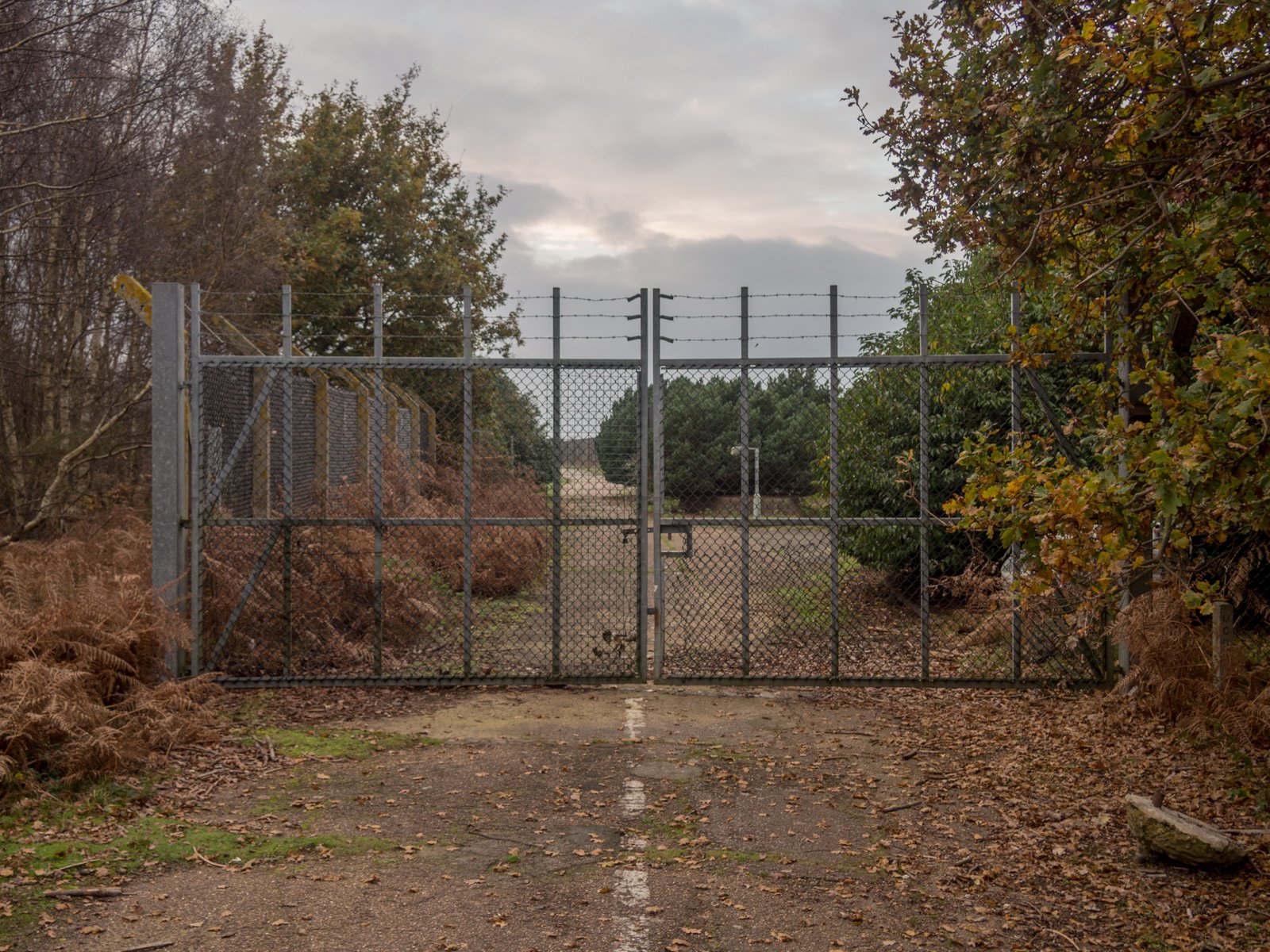
The East Gate at RAF Woodbridge, Suffolk, near where the Rendlesham Forest incident began on the night of December 26, 1980.Source ↗ 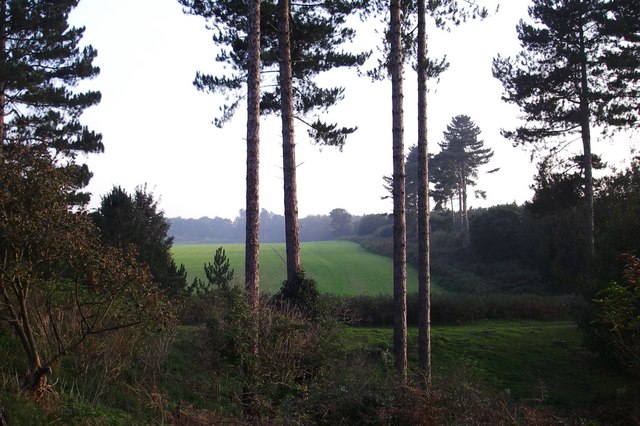
The stand of Corsican pines in Rendlesham Forest identified by researchers as the reputed landing site.Source ↗ 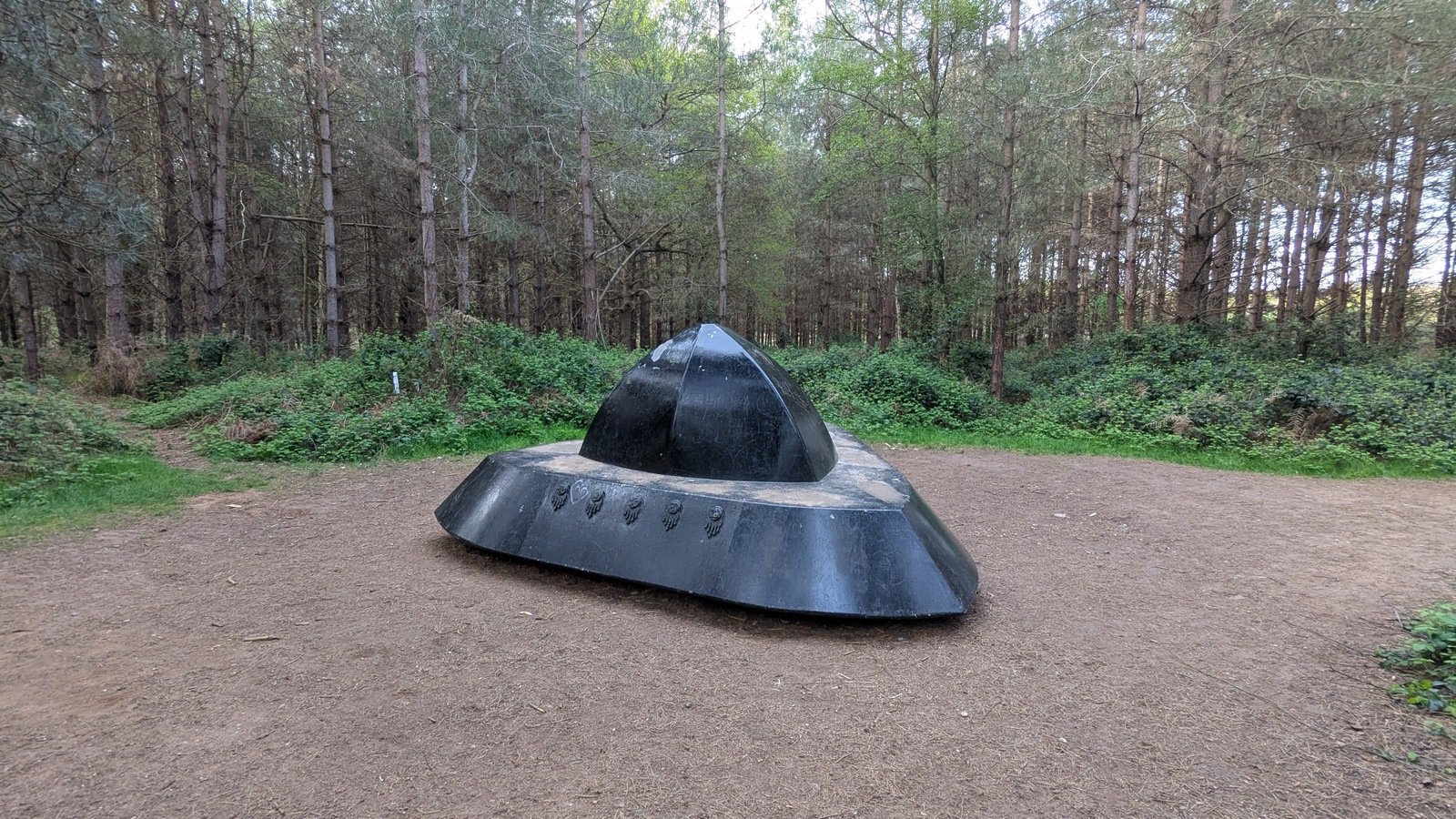
Modern UFO-themed sculpture/waymarker on the forest's public 'UFO Trail,' commemorating the incident.Source ↗ 
Redrawing of the glyphs Sergeant Jim Penniston says he copied from the craft's surface into his notebook that night.Source ↗