The Roswell Incident
In early July 1947, the U.S. Army Air Forces announced it had recovered a 'flying disc' from a ranch near Roswell, New Mexico — then retracted the claim within hours. That single press release, buried for three decades and resurrected in 1978, grew into the most famous and most contested UFO story ever told.
- When
- July 1947
- Where
- Roswell, NM, USA
- Witnesses
- 30
- Physical evidence
- Yes
- Military involvement
- Yes
The Sighting
In mid-June 1947, ranch foreman William 'Mac' Brazel found a field of odd debris scattered across the Foster ranch, roughly 75 miles northwest of Roswell, New Mexico: rubber strips, tinfoil-like sheets, tough paper, and sticks. He thought little of it until late June, when pilot Kenneth Arnold's sighting of nine fast-moving objects near Mount Rainier ignited a nationwide 'flying saucer' craze. On July 7, Brazel drove into Roswell and reported his find to Sheriff George Wilcox, who called the Roswell Army Air Field (RAAF), home of the 509th Bomb Group — at the time the world's only atomic-bomb unit.
Major Jesse Marcel, the base intelligence officer, collected the debris. On July 8, 1947, RAAF public information officer Walter Haut issued a press release stating that the military had recovered a 'flying disc.' The Roswell Daily Record ran the now-legendary headline: 'RAAF Captures Flying Saucer On Ranch in Roswell Region.' Within hours, Brigadier General Roger Ramey at Eighth Air Force headquarters in Fort Worth held a press conference declaring the debris to be the remains of a weather balloon and its radar reflector. Photographs showed Marcel posing with foil and balsa fragments. The story died — for 31 years.
The Investigation
Roswell was reborn in 1978, when ufologist Stanton Friedman interviewed a retired Jesse Marcel, who insisted the material he handled was 'not of this earth' and that the weather-balloon display had been a staged swap. Books by Charles Berlitz, William Moore, Kevin Randle, and Donald Schmitt followed, assembling testimony from dozens of aging witnesses. The narrative expanded dramatically: memory-metal foil that unfolded itself, structural beams with 'hieroglyphic' markings, a second crash site, and — most sensationally — the recovery of small non-human bodies and a secret autopsy.
Under congressional pressure driven by New Mexico Representative Steven Schiff, the General Accounting Office ordered a records search in 1994. The U.S. Air Force responded with a nearly 1,000-page report, 'The Roswell Report: Fact vs. Fiction in the New Mexico Desert.'
The witness base itself splintered into competing, mutually incompatible versions of events — a fact that gets lost in popular retellings but troubles serious researchers on both sides. Charles Berlitz and William Moore's 1980 book 'The Roswell Incident' established the modern template, built around Marcel's account and roughly two dozen additional witnesses. Kevin Randle and Donald Schmitt's 1991 book 'UFO Crash at Roswell' pushed the story further, proposing a second, separate crash site — the 'Boaz' or Corn Ranch site — distinct from the debris field Brazel found, where bodies were allegedly recovered. Later researchers, including Randle himself, grew skeptical of some of their own earlier sourcing after re-investigating key informants. By the 2000s, three incompatible core narratives coexisted in the literature — debris only; debris plus bodies at one site; debris plus bodies at two separate sites — a fragmentation that skeptics cite as evidence of legend accretion and that some proponents attribute to genuine deliberate disinformation seeded by the military itself to muddy the trail.
The Witnesses
Jesse Marcel remained the case's central figure even in death. His 1978 interview relaunched the story; his son, Jesse Marcel Jr., later added his own claim of seeing debris etched with 'purple-hued hieroglyphics' as a boy — a detail that skeptics matched to adhesive tape printed with flower and geometric symbols, standard issue on the Project Mogul balloon trains. Mac Brazel never lived to see any of it: he died in 1963, fifteen years before Friedman's interview reopened the case. His children later recounted family lore that soldiers had detained him and warned him to silence, though contemporary 1947 records show Brazel giving a calm radio interview about the balloon shortly after the retraction, at odds with a coerced-silence narrative built decades later.
The case's most theatrical witness was Glenn Dennis, a young Roswell mortician who by the 1990s was telling audiences that the base had called him about child-sized caskets and that a nurse had described handling small alien bodies during an autopsy. Investigators pressed him for the nurse's name; Dennis gave one, then another, and ultimately admitted he could not substantiate her existence — a collapse that badly damaged his credibility. It did not stop him from co-founding, with original RAAF spokesman Walter Haut, the International UFO Museum and Research Center in downtown Roswell in 1991. Haut himself left a final twist: a sworn affidavit, sealed until after his 2005 death, in which he claimed he had personally seen debris and one alien body in a hangar — a posthumous statement ufologists treat as a deathbed confession and skeptics treat as an old man's late elaboration of a story he'd been telling, in shifting form, for years.
The Evidence
The 1994 Air Force report concluded the debris came from Project Mogul, a then-top-secret program that flew trains of balloons carrying acoustic sensors designed to detect Soviet nuclear tests. Mogul Flight 4, launched from Alamogordo on June 4, 1947, was never recovered and its projected path passed near the Foster ranch. The mix of neoprene balloons, foil radar reflectors, balsa sticks, and tape printed with flower-like symbols matches witness descriptions of the debris remarkably well — including the 'hieroglyphics.' A 1997 follow-up report, 'Case Closed,' attributed the body stories to anthropomorphic crash-test dummies dropped in high-altitude experiments during the 1950s, combined with memory conflation over decades — the timeline mismatch (dummy drops happened years after 1947) is itself a point critics raise against the Air Force's own explanation.
The most tangible pro-conspiracy artifact is bureaucratic, not physical: the GAO's 1995 report found that Roswell Army Air Field's administrative records for the exact window in question — March 1945 through December 1949 — had been destroyed at some unknown time, by persons unknown, without documented authorization. That gap proves nothing specific and permits everything.
The Explanations
Skeptics note that no body testimony surfaced before 1978, that key accounts contradict each other on crash locations, debris descriptions, and body counts, and that several star witnesses were exposed as unreliable. Proponents counter that Mogul flight records for Flight 4 are incomplete, that Marcel was an experienced intelligence officer unlikely to mistake balloon trash for something anomalous, and that the military's rapid reversal and later secrecy look like textbook information management.
Modern Developments
The debris field itself remains privately owned ranchland, but it has become a minor pilgrimage site: UFO tour operators run guided trips out to the general vicinity, and a modest historical marker on U.S. Route 285 notes the town's place in the story for travelers who never make it as far as the museum downtown. Roswell has become a permanent fixture of the UAP disclosure conversation even as its 1947 core keeps shrinking under scrutiny. In 1989, researcher William Moore admitted under pressure that he had knowingly fed disinformation to fellow ufologists during the 1980s, undermining the notorious 'Majestic-12' documents that had briefly seemed to prove a government retrieval program. The 1995 'Alien Autopsy' film, marketed worldwide as leaked Roswell footage and watched by tens of millions, was confessed a hoax by its creators in 2006 — but not before minting a new generation of believers. In 2020, an Air Force historian declassified an account of a circa-1951 incident in which two Roswell-based airmen, testing radiation gear after an atomic detonation, wore bulky protective suits into the desert and encountered a woman who fainted at the sight of them — offered as a plausible seed for 'alien' body-suit sightings misdated to 1947.
The case now sits inside a much larger institutional debate. David Grusch's 2023 congressional testimony about an alleged secret U.S. crash-retrieval program revived Roswell-style claims at the highest level, though without public evidence. In March 2024, the Pentagon's newly formed All-domain Anomaly Resolution Office (AARO) published the first volume of its historical review of U.S. government involvement with UAP, addressing Roswell directly and concluding it found no verifiable evidence that any extraterrestrial craft or bodies were ever recovered there or anywhere else — a finding ufologists call simply the latest denial in a 77-year pattern, and skeptics call confirmation. Barack Obama, asked about Roswell in a 2015 GQ interview after leaving classified briefings behind, remarked dryly that the reality of secret programs 'is generally so much more mundane' than people expect, adding that Roswell itself 'seems so tame' next to modern conspiracy theories.
Why It Endures
Roswell is the founding myth of UFO crash-retrieval lore, the reference point against which every later recovery story — Kecksburg, Shag Harbour, Varginha — is measured. It has everything: an official admission ('flying disc') followed by an official retraction, a genuinely secret government program at its core, and a 30-year silence that let memory and legend fuse. The International UFO Museum now draws visitors year-round, and Roswell's annual UFO Festival — held every July since 1995 and pulling an estimated 90,000 visitors to a town of 48,000 — has turned the crash into the region's leading industry, complete with parades, costume contests, and an 'Alien Chase' 5K. Whether one reads it as a mundane balloon crash amplified by Cold War secrecy or as the original cover-up, Roswell demonstrates the central dynamic of ufology: when institutions conceal anything, people will suspect they conceal everything — and the town that a weather balloon put on the map has spent thirty years, and counting, cashing that suspicion at the door.
Official investigation
Project Mogul explanation (1994 USAF report); 'crash test dummies' addendum (1997)
Evidence & media
4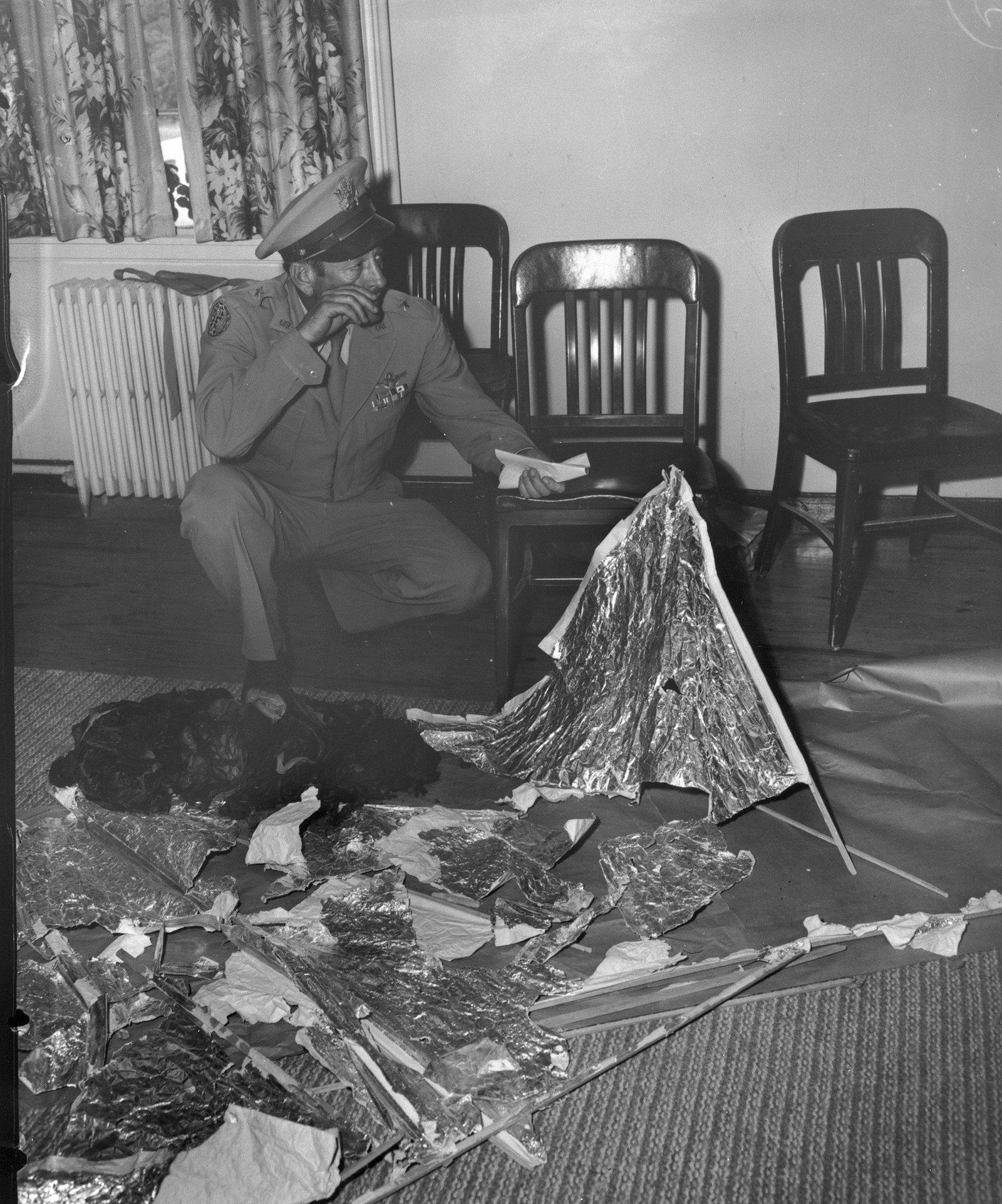
Brig. Gen. Roger Ramey (right) and Col. Thomas DuBose examine debris in Ramey's Fort Worth office, July 8, 1947 — the press event at which the Army walked back its 'flying disc' announcement.Source ↗ 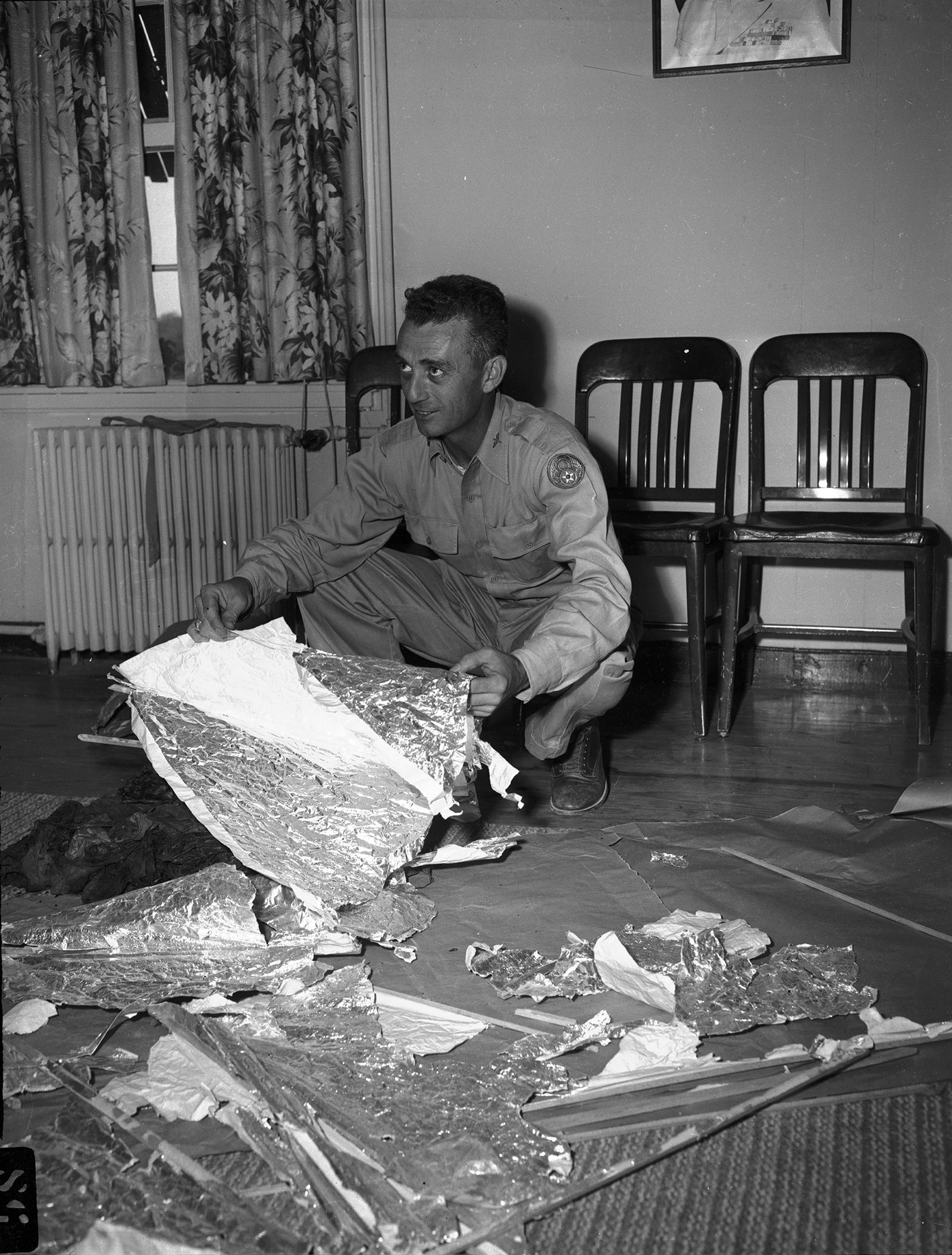
Maj. Jesse Marcel of the 509th Bomb Group poses with recovered debris in Ramey's office, July 8, 1947.Source ↗ 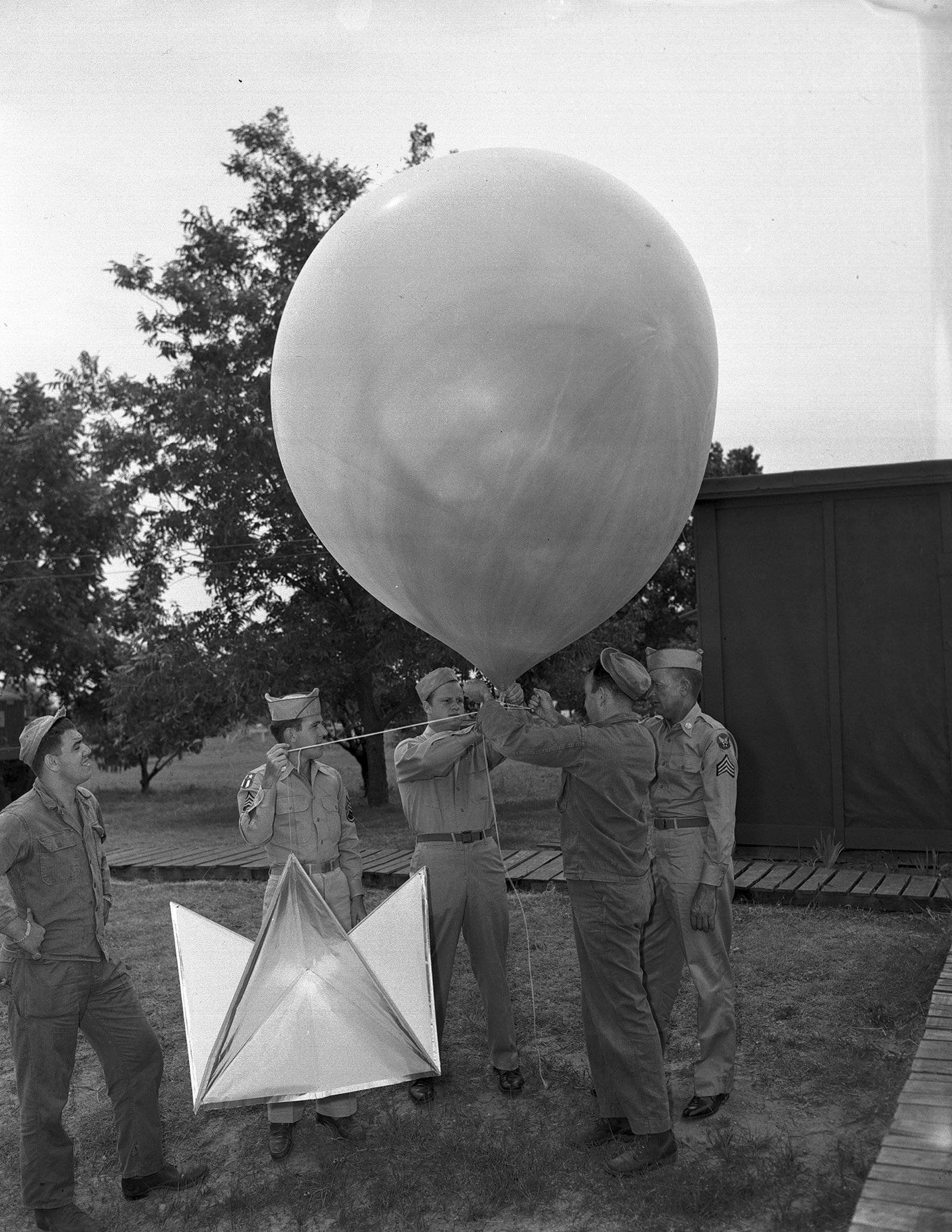
The Army's follow-up photo session, July 11, 1947, presenting the debris as the remains of a weather balloon and radar target.Source ↗ 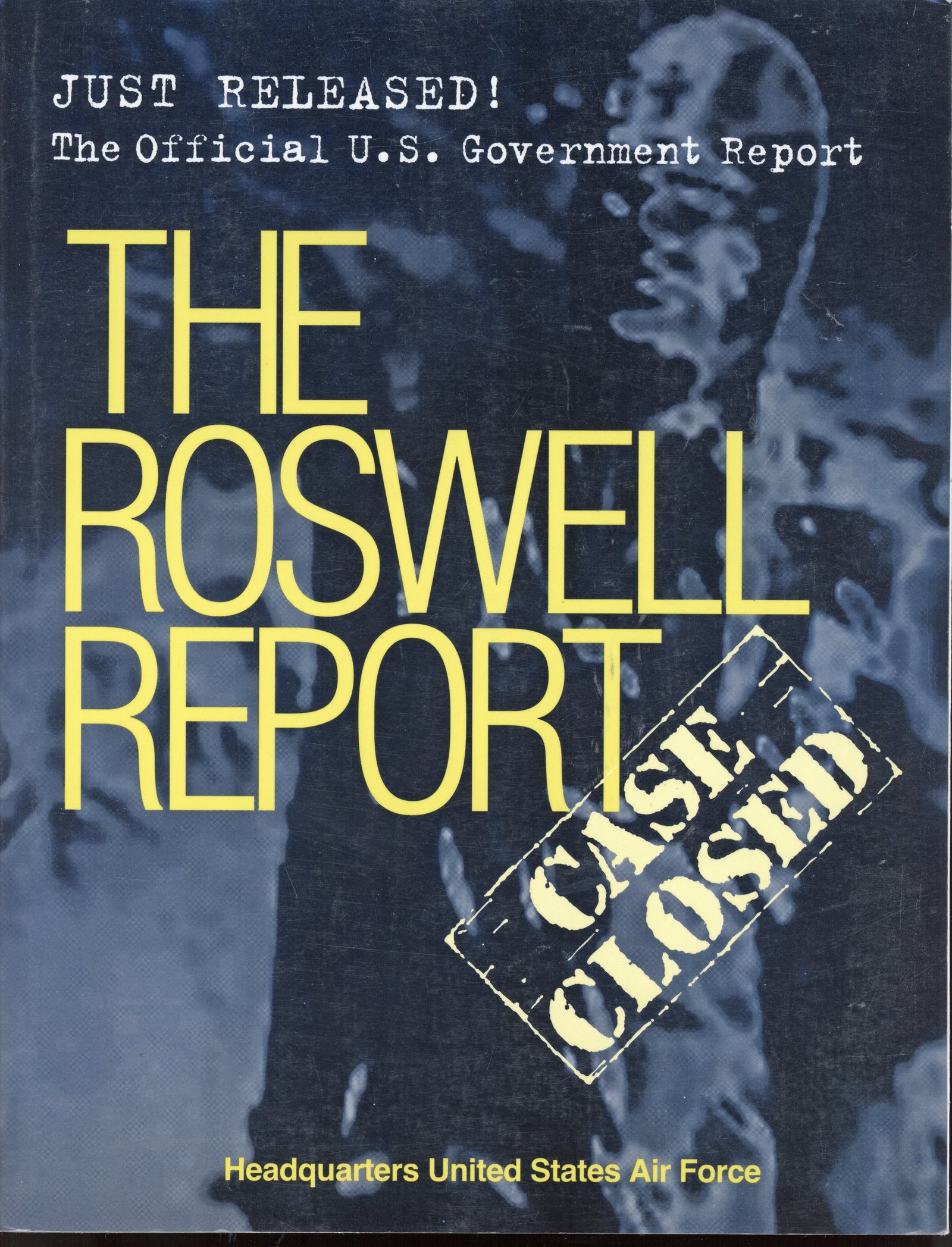
Cover of 'The Roswell Report: Case Closed,' the US Air Force's 1997 official report attributing the debris and any body reports to Project Mogul balloons and anthropomorphic test dummies.Source ↗